

A Present Value Calculator helps you find what a future payment or investment is worth today. It uses a discount rate, the time period, and the amount you expect to receive.
Present Value Calculator
What a future amount is worth today · results update as you type
Present Value Calculator – Formula, Annuity, Discount Rate & Real-World Examples
Money has a different value today than it will have in the future. If someone offers you $10,000 today or the same amount five years from now, these two options are not financially equal. You could invest today's money and earn a return before the five years end. Inflation can also reduce the purchasing power of money over time.
A Present Value Calculator helps you find what a future payment or investment is worth today. It uses a discount rate, the time period, and the amount you expect to receive. You can use present value to compare investments, estimate future income, review loan offers, and make better financial decisions.
Calculate Present Value Using Our Calculator
Our present value calculator helps you estimate the current worth of a future amount. Enter the amount you expect to receive, choose a discount rate, and set the number of years. The calculator applies the present value formula and shows the result without requiring manual calculations.
You can also use it to explore annuity payments and different compounding methods. This makes it useful for a single future payment, regular income, or an investment with several payment periods. A present value calculator with discount rate can help you compare how different rates change the result.
How to Use the Present Value Calculator
Start by selecting the calculation type. Choose a single future payment if you expect to receive one lump sum. Choose the annuity option if you expect regular payments over a set period. Enter the required values and select the correct compounding frequency.
For a single-payment calculation, you usually need the future amount, annual discount rate, and number of years. If the calculator offers monthly, quarterly, or continuous compounding, select the method that matches your financial situation. The result shows the today's value of the future money.
What Information Do You Need to Calculate Present Value?
The required information depends on the type of calculation. A single future payment needs fewer inputs than an annuity or a series of uneven cash flows. Using the correct values is important because even a small change in the discount rate or time period can affect the result.
| Input | Meaning |
| Future value | The amount you expect to receive later |
| Discount rate | The rate used to convert future money into today's value |
| Number of periods | How long you must wait for the payment |
| Compounding frequency | How often the rate is applied |
| Payment amount | The regular amount received in an annuity |
| Payment timing | Whether payments occur at the beginning or end of each period |
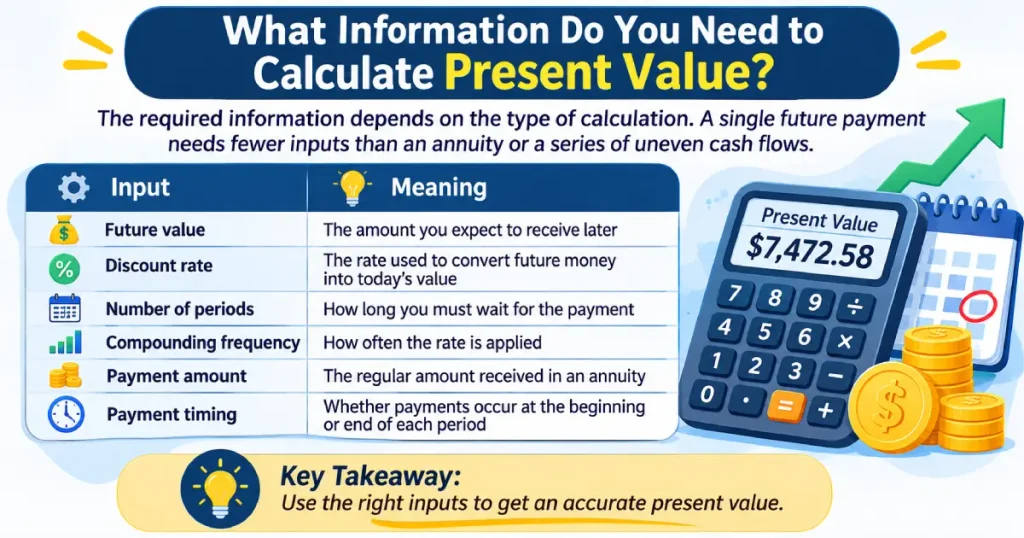
For example, a future payment of $10,000 received in five years needs a future amount of $10,000, a 6% annual discount rate, and five years. An annuity calculation also needs the payment amount and the total number of payments.
Present Value Calculation Example: $10,000 in 5 Years at 6%
Suppose you will receive $10,000 after five years. You want to know how much that payment is worth today if your annual discount rate is 6%. The calculation uses the single-payment present value formula.
Here, FV is $10,000, r is 0.06, and n is 5.
The present value is approximately $7,472.58. This means that $7,472.58 invested today at a 6% annual return would grow to about $10,000 in five years, assuming annual compounding and a constant rate.
The difference between the future amount and its present value is the discount amount:
What Is Present Value and Why Does It Matter?
Present value is the current worth of money you expect to receive in the future. It measures how much a future payment is worth today after considering the time value of money and a suitable discount rate. In finance, people use it to compare payments that occur at different times.
The present value of money matters because money available today can earn a return. Future payments also carry uncertainty, and inflation can reduce their purchasing power. Present value brings future amounts into today's terms, making financial comparisons easier and more meaningful.
Understanding the Time Value of Money
The time value of money is a basic idea in finance. It explains why one dollar today is generally worth more than one dollar received later. Money available now can be saved, invested, or used to reduce debt. These choices may create financial benefits before a future payment arrives.
For example, imagine you receive $5,000 today. You place it in an account that earns 5% annually. After one year, it becomes $5,250 before taxes and fees. If you receive the same $5,000 one year later, you miss the chance to earn that return during the first year.
Why Is Money Worth More Today Than in the Future?
Three major factors explain this difference. The first is investment return. Money available today may earn interest or investment income. The second is inflation. Prices may rise over time, so the same amount of money may buy fewer goods and services in the future.
The third factor is risk. A future payment may be delayed, reduced, or never received. A discount rate can reflect some of these concerns, depending on the purpose of the calculation. However, a simple present value result does not guarantee that a future payment will arrive.
How Present Value Helps in Financial Planning
Present value helps people compare financial choices on a common basis. You can use it to evaluate a pension offer, estimate the value of future rental income, or compare a lump-sum payment with monthly installments. Businesses also use it when they review projects that produce income over several years.
It is especially useful when the timing of money matters. A payment received today may be more attractive than the same payment received later. However, the best choice also depends on taxes, fees, risk, liquidity, and personal needs. Present value supports financial planning, but it should not replace a complete review of the decision.
Present Value Formula Explained With Examples
The present value formula converts a future amount into its value today. It does this by dividing the future amount by a growth factor based on the discount rate and the number of periods. The result depends on the assumptions you enter, especially the rate and timing.
This method is known as financial discounting. It is widely used in investment valuation and discounted cash flow analysis. The formula is simple for one future payment, while annuities and uneven cash flows require additional calculations.
Present Value Formula for a Single Future Payment
The standard formula for a single future payment is:
In this formula, PV means present value, FV means future value, r is the discount rate per period, and n is the number of periods. The formula assumes that the discount rate remains constant and that the rate and time period use matching units.
For example, if you expect $20,000 in three years and use an annual discount rate of 5%, the calculation is:
The future payment of $20,000 has a present value of about $17,276.76 at a 5% annual discount rate.
What Does Each Variable in the PV Formula Mean?
Each variable has a specific role. The future value is the amount expected at a later date. The discount rate represents the return or rate used to convert that amount into a current value. The number of periods measures the time until the payment arrives.
| Symbol | Meaning | Example |
| PV | Present value | $7,472.58 |
| FV | Future value | $10,000 |
| r | Discount rate per period | 6% |
| n | Number of periods | 5 years |
| (1+r) | Growth factor per period | 1.06 |
The rate and period must match. If you use an annual rate, the number of periods should normally represent years. If you use a monthly rate, the number of periods should represent months. Mixing an annual rate with monthly periods can produce an incorrect result.
Step-by-Step Present Value Formula Calculation
Consider a future payment of $15,000 that you expect to receive in four years. Assume an annual discount rate of 7%. First, identify the future amount, discount rate, and number of years. Then place these values into the formula.
The present value is approximately $11,443.46. In other words, $11,443.46 today would grow to around $15,000 in four years at 7% annual compounding. This calculation assumes no additional deposits or withdrawals.
How to Rearrange the Formula to Find the Discount Rate or Time Period
Sometimes you know the present value and future value but need to find the discount rate. You can rearrange the formula:
Suppose an investment grows from $8,000 to $10,000 over five years. Its implied annual growth rate is:
You can also solve for the number of periods when the present value, future value, and rate are known:
This requires a logarithmic calculation. It helps estimate how long an amount needs to grow from its current value to a target future amount at a fixed rate.
How to Choose the Right Discount Rate for Present Value?
The discount rate has a direct effect on present value. A higher rate produces a lower present value because it assumes a greater return or a larger adjustment for time and risk. A lower rate produces a higher present value.
There is no single discount rate that works for every situation. Your choice should reflect the purpose of the calculation, the risk of the future cash flows, inflation assumptions, and the return available from similar alternatives. A present value calculator with different interest rates helps you compare possible outcomes.
Discount Rate vs Interest Rate
An interest rate is the amount charged on borrowed money or earned on savings and investments. A discount rate is the rate used to convert future money into its present value. The two rates can be equal in some calculations, but they do not always mean the same thing.
For example, you might use the expected return on a similar investment as a discount rate when comparing investment opportunities. A business may use a required rate of return when evaluating a project. The correct rate depends on the cash flows being valued and the decision being made.
Risk, Inflation, and Opportunity Cost
Risk matters because future payments are not always certain. A payment from a reliable source may require a different discount rate from a payment linked to an uncertain business project. A higher rate may reflect greater risk, but choosing a rate does not remove that risk.
Inflation also affects the value of money. If you want to estimate purchasing power, you need to understand whether your cash flows and discount rate are expressed in nominal or real terms. Opportunity cost is another important factor. It represents the return you give up by choosing one option instead of another.
How Different Discount Rates Affect Present Value
Consider $10,000 received in five years. The table below shows how the present value changes at different annual discount rates. It assumes annual compounding and one payment at the end of year five.
| Annual discount rate | Present value of $10,000 |
| 2% | $9,057.31 |
| 4% | $8,219.27 |
| 6% | $7,472.58 |
| 8% | $6,805.83 |
| 10% | $6,209.21 |
The pattern is clear. As the discount rate increases, the present value decreases. This is why you should test more than one reasonable rate when the correct rate is uncertain. A sensitivity comparison shows how much your result depends on that assumption.
Present Value Calculation Examples for Different Scenarios
Real financial decisions often involve different payment amounts, time periods, and discount rates. A single formula can help with a future lump sum, but the inputs must match the situation. The examples below show how to calculate present value for common financial questions.
These examples assume fixed annual rates and annual compounding unless stated otherwise. They do not include taxes, fees, or changes in the discount rate. Actual investment results may differ from these estimates.
Present Value of $1,000 Received in 5 Years
Suppose you expect to receive $1,000 after five years. If you use a 6% annual discount rate, the calculation is:
The present value is approximately $747.26. This means that $747.26 invested today at 6% annually would grow to around $1,000 in five years. This is an example of how the discount factor reduces a future amount to its present value.
Present Value of $10,000 at Different Interest Rates
The present value of $10,000 depends on both the discount rate and the time you must wait. Consider a payment due in ten years. The following table compares several annual rates.
| Annual discount rate | Present value |
| 3% | $7,441.95 |
| 5% | $6,139.13 |
| 7% | $5,083.49 |
| 8% | $4,631.93 |
| 10% | $3,855.43 |
At 5%, the present value is about $6,139.13. At 10%, it falls to about $3,855.43. The future payment stays the same, but the rate changes the amount considered equivalent today.
Present Value of a Future Investment or Savings
Imagine you plan to receive $25,000 from an investment in eight years. You use a 5% annual discount rate to estimate its present value. The calculation is:
This means the future $25,000 has a present value of about $16,922.71 at the selected rate. You can use this result as one part of an investment valuation. You should also consider the original cost, possible losses, taxes, and the timing of any additional cash flows.
How Much Is $100,000 Worth Today?
The answer depends on when you will receive the $100,000 and which discount rate you use. For example, if the payment arrives in ten years, different annual rates produce different present values.
| Annual discount rate | Present value of $100,000 in 10 years |
| 3% | $74,409.39 |
| 5% | $61,391.33 |
| 8% | $46,319.35 |
| 10% | $38,554.33 |
At a 5% annual discount rate, present value of $100,000 in 10 years is approximately $61,391.33. This does not mean the future payment will have exactly that purchasing power. It means that $61,391.33 is the mathematical present value when discounted at 5% annually.
Present Value Table: How Much Is Future Money Worth Today?
A present value table shows the current value of a future amount at different rates and time periods. It often uses a present value interest factor, or PVIF, instead of displaying the full calculation each time. You multiply the future amount by the factor to find its present value.
A PV table is useful when you want to compare several rates or periods quickly. However, the factors may be rounded, so a calculator or spreadsheet can provide more precise results. Always check that the table uses the same compounding method as your calculation.
Present Value of $1,000 at Different Discount Rates
The following table shows the present value of $1,000 received after five years. It uses annual compounding.
| Annual discount rate | PV factor | Present value |
| 2% | 0.9057 | $905.73 |
| 4% | 0.8219 | $821.93 |
| 6% | 0.7473 | $747.26 |
| 8% | 0.6806 | $680.58 |
| 10% | 0.6209 | $620.92 |
The factor is calculated using:
Then:
At 6%, the PVIF for five years is about 0.7473. Multiplying $1,000 by this factor gives a present value of approximately $747.26.
Present Value Factors for Different Time Periods
A longer waiting period usually reduces present value when the discount rate is positive. The table below shows selected PVIF values at a 5% annual discount rate.
| Years | Present value factor |
| 1 | 0.9524 |
| 2 | 0.9070 |
| 3 | 0.8638 |
| 5 | 0.7835 |
| 10 | 0.6139 |
| 15 | 0.4810 |
| 20 | 0.3769 |
These factors help you understand how time affects a future payment. For example, $10,000 received in ten years has a present value of about $6,139.13 at 5%. The same $10,000 received in five years has a higher present value of about $7,835.26.
How to Read and Use a Present Value Table
Find the row that matches the number of periods and the column that matches the discount rate. The value where they meet is the present value factor. Multiply that factor by the future amount to estimate the current value.
For example, if you expect $5,000 after ten years and the table gives a factor of 0.6139 at 5%, the calculation is:
The result is an estimate because the table factor is rounded. For more accurate results, use the full formula or a present value calculator using PVIF.
Present Value of an Annuity: Regular Payments Explained
An annuity is a series of equal payments made at regular intervals. These payments may occur monthly, quarterly, or annually. The present value of an annuity is the total current value of all those future payments after discounting each payment for its timing.
A present value calculator with annuity can help you compare regular income with a lump sum. The result depends on the payment amount, discount rate, number of payments, and payment timing. An ordinary annuity and an annuity due use different timing assumptions.
Present Value of an Ordinary Annuity
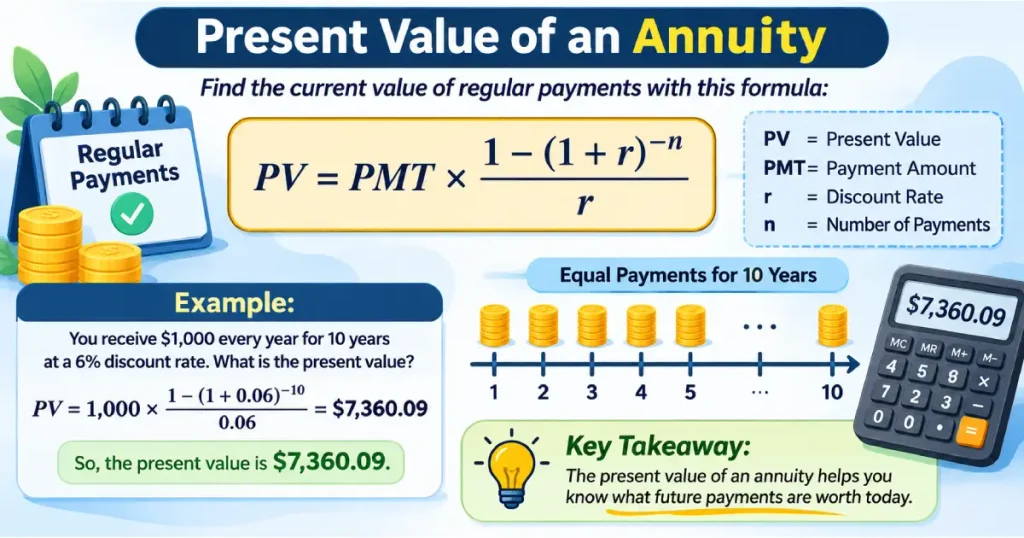
An ordinary annuity makes payments at the end of each period. For example, a loan payment made at the end of each month follows this timing pattern. The present value formula is:
Here, PMT is the payment amount, r is the rate per period, and n is the number of payments. Suppose you receive $1,000 at the end of each year for ten years. At a 6% annual discount rate:
The ten annual payments have a combined present value of about $7,360.09.
Present Value of an Annuity Due
An annuity due makes payments at the beginning of each period. Rent paid at the start of each month is a common example. Since each payment arrives earlier than an ordinary annuity payment, the present value is higher when the payment amount, rate, and number of periods stay the same.
You can calculate an annuity due by multiplying the ordinary annuity present value by one plus the rate per period:
Using the previous example:
The annuity due has a higher present value because each payment arrives one period earlier.
Present Value of an Annuity Formula With Examples
Suppose you receive $500 every month for three years. You use a monthly discount rate of 0.5%, which is equivalent to 6% nominal annual interest divided by 12. The total number of payments is 36.
This is the approximate present value of the monthly payment stream. A present value calculator for monthly payments should use the monthly rate and 36 monthly periods. It should not use the annual rate with 36 periods.
Present Value of a Perpetuity
A perpetuity is a payment stream that continues indefinitely, with equal payments at regular intervals. Under the basic perpetuity model, the present value is:
Suppose an investment pays $500 every year forever and the annual discount rate is 5%.
The estimated present value is $10,000. This formula assumes the payments remain constant and continue indefinitely. A growing perpetuity uses a different formula and requires the growth rate to remain below the discount rate.
Present Value of Uneven Cash Flows and Multiple Payments
Not every investment produces equal payments. A business project may generate $2,000 in its first year, $3,500 in its second year, and $5,000 in its third year. These uneven payments need separate discount factors because they arrive at different times.
The present value of multiple payments is the sum of the present value of each future cash flow. This method is a key part of discounted cash flow analysis. It helps investors and businesses estimate the value of income that arrives over several periods.
How to Calculate the Present Value of Multiple Cash Flows
Use the single-payment formula for each cash flow, then add the results together. The general formula is:
Here, (CF_t) represents the cash flow received in period t. The discount rate must match the period length. If the cash flows arrive annually, use an annual rate and annual periods.
For example, assume an investment produces $2,000 after one year, $3,000 after two years, and $4,000 after three years. At a 5% annual discount rate, each payment receives its own discount factor.
| Year | Future cash flow | Present value at 5% |
| 1 | $2,000 | $1,904.76 |
| 2 | $3,000 | $2,721.09 |
| 3 | $4,000 | $3,455.35 |
| Total | $9,000 | $8,081.20 |
The total present value is approximately $8,081.20. This is the current value of the three future payments under the 5% discount-rate assumption.
Discounting Each Cash Flow Separately
Each payment has a different time value. A payment received next year is discounted for one period. A payment received in three years is discounted for three periods. This is why you cannot simply add all future payments and discount the total as if you receive it on one date.
For accurate cash flow valuation, record each payment and its expected date. Then apply the correct discount factor to each one. If payments occur monthly or quarterly, use matching periods and rates. This method is also useful for a present value of multiple payments calculation.
Present Value of Future Income Streams
Future income streams may include rental income, pension payments, royalties, or business revenue. Their present value depends on the amount, timing, and reliability of each payment. If the payments change over time, calculate each period separately or use a suitable cash flow model.
For example, a rental property may produce monthly rent, but the owner may also face maintenance costs, vacancies, taxes, and insurance. A useful valuation should include both cash inflows and cash outflows. Discounting only the expected rent can overstate the property's financial value.
How to Calculate Present Value in Excel?
Excel can calculate present value with its built-in PV function. This is useful when you need to test several rates, payment amounts, or time periods. It also helps when you want to keep your assumptions and calculations in one spreadsheet.
Excel treats payments and receipts according to cash flow signs. A payment made today is usually entered as a negative amount, while money received is usually positive. You should also match the rate and number of periods to the payment schedule.
Using the PV Function in Excel
The Excel PV function uses this structure:
=PV(rate, nper, pmt, [fv], [type])
The rate is the interest or discount rate per period. Nper is the total number of periods. Pmt is the payment made each period. FV is an optional future balance, and type tells Excel when payments occur. Use 0 for payments at the end of a period and 1 for payments at the beginning.
For example, to calculate the present value of $10,000 received in five years at 6% annually, enter:
=PV(6%,5,0,10000,0)
Excel may return a negative value because of its cash flow sign convention. The absolute amount is approximately $7,472.58. The sign does not mean the calculation is wrong.
Excel Formula for a Single Future Payment
You can also calculate present value directly without the PV function. If cell A1 contains the future amount, A2 contains the annual discount rate, and A3 contains the number of years, use:
For example, enter 10000 in A1, 6% in A2, and 5 in A3. The formula returns approximately $7,472.58. This method makes the calculation easy to inspect and adjust.
Example of Present Value Calculation in Excel
Suppose you want to compare the present value of $10,000 due in five years at 4%, 6%, and 8%. Put the future amount in cell A2 and the discount rates in B2, C2, and D2. Use a formula such as =A2/(1+B$1)^$A$3, adjusting the cell references to match your spreadsheet.
The result will show how the present value changes when the rate changes. This type of spreadsheet calculation is useful for sensitivity analysis. It also makes it easier to share assumptions with a business partner or financial adviser.
Common Excel Present Value Mistakes
One common mistake is mixing annual rates with monthly periods. If payments occur monthly, divide a nominal annual rate by 12 and use the total number of months, provided that this matches the rate convention. Another mistake is selecting the wrong payment timing. Beginning-of-period payments need different treatment from end-of-period payments.
Excel's NPV function also needs careful use. It generally discounts future cash flows that occur at the end of each period. A cash flow occurring immediately, at time zero, should be added separately rather than included as a future period in the NPV range.
Present Value vs Future Value vs Net Present Value
Future value, present Value and net present value are related financial measures, but they answer different questions. Present value estimates what future money is worth today. Future value estimates what money today may grow to later. Net present value compares the present value of future cash flows with an initial cost or investment.
Understanding these differences helps you choose the right method. Use present value when you want to compare future money with today's money. Use future value when you want to estimate growth. And use net present value when you want to assess whether a project or investment may create value after considering its cost.
Present Value vs Future Value: Key Differences
Present value moves money backward in time through discounting. Future value moves money forward through compounding. Both use a rate and a time period, but the direction of the calculation is different.
| Feature | Present value | Future value |
| Main question | What is future money worth today? | What may today's money be worth later? |
| Process | Discounting | Compounding |
| Typical use | Investment valuation | Savings and growth estimates |
| Basic formula | (PV=FV/(1+r)^n) | (FV=PV(1+r)^n) |
For example, $7,472.58 invested today at 6% annually grows to approximately $10,000 in five years. In the reverse direction, the present value of $10,000 received in five years at 6% is approximately $7,472.58.
Present Value vs Net Present Value (NPV)
Present value measures the current worth of future cash flows. Net present value goes one step further. It subtracts the initial investment or cost from the present value of the future cash flows.
Suppose a project requires an initial investment of $8,000 and has future cash flows with a combined present value of $9,500. Its net present value is:
The positive result means the estimated present value of the future cash flows is greater than the initial cost under the selected assumptions. A negative NPV means the discounted cash flows do not cover the initial investment.
When Should You Use PV, FV, or NPV?
Use PV when you need to compare a future payment with money available today. The use FV when you want to estimate how savings or an investment may grow over time. Use NPV when you need to assess a project with an initial cost and future cash flows.
These measures are tools, not guarantees. A positive NPV does not ensure a project will succeed. The result depends on the quality of your cash flow estimates and the discount rate. Review risks, taxes, fees, and alternative uses of your money before making a final decision.
Real-World Applications of Present Value in Financial Decisions
Present value is used in personal finance, business planning, and investment analysis. It gives future payments a common value so you can compare choices that have different payment dates. This is important when one option pays money now and another pays it over several years.
The method is useful for both individuals and organizations. However, the result is only as reliable as the assumptions behind it. You should use realistic cash flow estimates and a discount rate that fits the purpose of the analysis.
Evaluating Investment Opportunities
Investors use present value to estimate what future income from an investment is worth today. This may include dividends, rental income, bond payments, or expected business cash flows. The calculation helps compare the value of expected income with the amount required to invest.
For example, an investment may cost $5,000 today and produce future payments with a combined present value of $5,800. The estimated value above the initial cost is $800. Before investing, you should also review the risk of missed payments, changes in market conditions, and the possibility of losing your original investment.
Calculating Loan and Mortgage Values
Present value is important in loan and mortgage calculations because a loan involves money received today and payments made over time. The present value of the scheduled payments can help explain how the payment amount, interest rate, and loan term relate to the amount borrowed.
For a fixed-rate loan, the payment schedule usually contains equal periodic payments. The present value of those payments is linked to the principal balance, assuming the stated rate and payment timing. Fees, taxes, insurance, and variable rates may change the total cost of borrowing.
Retirement and Pension Planning
Retirement planning often involves comparing a lump sum with a stream of future payments. For example, a pension plan may offer a one-time payment or monthly income for a set period. Present value helps estimate the current value of those future payments.
A present value of retirement payments calculation depends on payment size, frequency, expected duration, and discount rate. A lifetime pension also involves uncertainty about how long payments will continue. A basic annuity formula cannot fully capture every feature of a pension, so review survivor benefits, inflation adjustments, taxes, and plan rules before choosing.
Business Valuation and Project Analysis
Businesses use discounted cash flow methods to estimate the value of projects, operations, and investment opportunities. They forecast future cash inflows and cash outflows, then discount those amounts to the present. The result helps decision-makers compare projects that may produce income over different time periods.
A strong analysis should include realistic revenue forecasts, operating costs, taxes, capital spending, and working capital needs. It should also test different discount rates and business assumptions. This gives managers a clearer view of the project's possible value and the risks that could affect its results.
FAQs
What Is the Present Value of $10,000 in 5 Years?
At a 6% annual discount rate, the present value of $10,000 received in five years is approximately $7,472.58.
What Is a Good Discount Rate for Present Value?
There is no single best discount rate. Choose a rate based on investment risk, inflation, opportunity cost, and your expected return.
Can Present Value Be Higher Than Future Value?
Yes, when the discount rate is negative. With a positive discount rate, present value is usually lower than future value.
How Do You Calculate Present Value Without a Calculator?
Use the formula PV=FV/(1+r)n. Divide the future amount by one plus the discount rate raised to the number of periods.
What Happens to Present Value When the Discount Rate Increases?
Present value decreases as the discount rate increases. This happens because future money is discounted more heavily.
Is Present Value the Same as Discounted Cash Flow?
No. Present value measures today's worth of future money, while discounted cash flow is a method that uses present value calculations to estimate the value of future cash flows.
What Is the Present Value of $10,000 in 10 Years at 5%?
At a 5% annual discount rate, the present value of $10,000 received in ten years is approximately $6,139.13.
What Is the Present Value of $100,000 in 20 Years?
At a 5% annual discount rate, $100,000 received in 20 years has a present value of approximately $37,688.95.
Should I Take a Lump Sum or Monthly Payments?
Compare the lump sum with the present value of all monthly payments. Also consider taxes, inflation, payment security, and your financial needs.
How Does Inflation Affect Present Value?
Inflation reduces the purchasing power of money over time. It can lower the real value of future payments, so consider inflation when choosing your discount rate.
Final Thoughts on Present Value
Present value helps you understand what future money is worth today. It is useful for evaluating investments, comparing payment options, reviewing loans, and planning for retirement. The basic formula works for one future payment, while annuity and discounted cash flow methods handle regular or uneven payments.
The most important part of a reliable present value calculation is choosing the right assumptions. Use matching rates and periods, check payment timing, and compare different discount rates when needed. A present value result is an estimate based on those inputs, not a promise of future returns. Use the calculator to test realistic scenarios before making important financial decisions.
Key Takeaways
- Core Formula: Present value equals Future Value divided by one plus the discount rate raised to the power of periods ($\text{PV} = \text{FV} \div (1 + r)^n$); discounting acts as compounding in reverse.
- Time & Value Equivalence: $10,000 received in 5 years is worth $7,472.58 today at a 6% discount rate — and inversely, that same $7,472.58 invested at 6% grows back to exactly $10,000 in 5 years.
- Discount Factor Precision: The Present Value Interest Factor (PVIF) for 10 years at an 8% rate is 0.4632, meaning $1,000 due in a decade is only worth $463.19 today.
- Contextual Discount Rates: There is no single universal discount rate; it depends entirely on your opportunity cost, prevailing inflation rates, or hurdle rate of return.
- Implied Rate Analysis: If you invest or pay $8,000 today to receive $10,000 in 4 years, your implied annual compound return rate is exactly 5.74%.
- Annuity Realities: Regular cash flows differ significantly from single sums; receiving $1,000 a year for 10 years at 6% has a present value of $7,360.09, not the nominal sum of $10,000.
- Horizon Sensitivity: Always state your assumed rate clearly; over long multi-decade horizons, even a single percentage point shift radically transforms present value outcomes.
Sources
- Khan Academy — " Present value 4 (and discounted cash flow) ", Finance & Capital Markets curriculum.
- Compound Interest Calculator — Future Values Calculator portal for growth and discounting projections.
- Khan Academy — Time Value of Money — Understand why the timing of money matters.
Use our Best Financial Calculators:
We provide free online calculators with easy explanations. Every calculator is tested using standard formulas and updated regularly to improve accuracy.
Here are our best Calculator tools below:
Future Value Calculator, Loan EMI Calculator,401k Calculator, SIP Calculator, Hourly to Salary Calculator , Future Property value calculator,
CPC,CPM & CTR Calculator, Losertown calorie calculator, Emergency Fund Calculator, Net Disposable Income (NDI)