
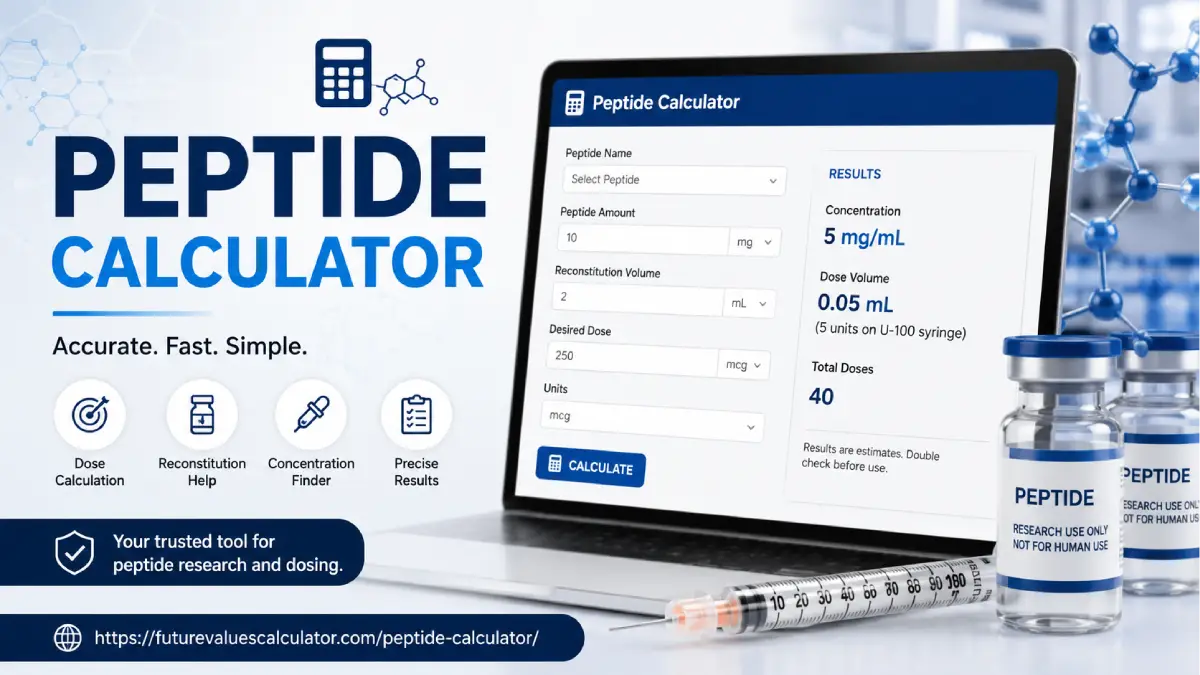
A peptide calculator is a simple tool that helps people work with peptides easily and correctly. Students, scientists, and researchers use it in biology, chemistry, and medicine to find peptide values. It gives quick results, saves time, and helps avoid mistakes.
Peptide Calculator
Dose Results
10 Units
0.10 ml
2.50 mg/ml
20 Doses
5,000 mcg
Syringe Fill: 10 / 100 Units
• Concentration = $\frac{\text{Total Quantity}}{\text{Water Volume}}$
• Draw Volume = $\frac{\text{Desired Dose}}{\text{Concentration}}$
In this article, you will learn what a peptide calculator is, how it works, why it is important, and how you can use it step by step. Everything is explained in simple English and active voice so that anyone can understand it.
What Is a Peptide?
A peptide is a short chain of amino acids. Amino acids are the building blocks of proteins. When a few amino acids join together, they form a peptide. When many amino acids join together, they form a protein.
For example:
- 2 amino acids = dipeptide
- 3 amino acids = tripeptide
- Many amino acids = protein
Peptides play important roles in the body. They help in hormones, enzymes, and cell communication.
What Is a Peptide Calculator?
A amino acid calculator is an online or software tool that helps you calculate different properties of a peptide. You just enter the peptide sequence (a string of letters that represent amino acids), and the calculator gives you results instantly.
Each letter in the sequence stands for one amino acid. For example:
- A = Alanine
- G = Glycine
- L = Leucine
So, a sequence like AGL represents a peptide made of three amino acids.
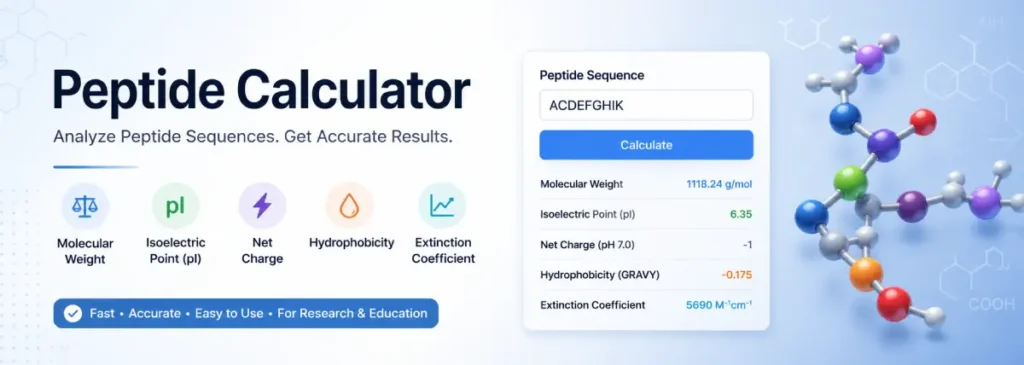
What Can a Peptide Calculator Do?
A dosage calculator can perform many useful calculations. Here are the most common ones:
1. Molecular Weight Calculation
The calculator tells you the molecular weight of a peptide. Molecular weight means how heavy the molecule is.
This is important because:
- You need it for lab experiments
- You use it to prepare solutions
- You measure accurate quantities
2. Isoelectric Point (pI)
The isoelectric point is the pH at which the peptide has no charge.
This helps you:
- Understand peptide behavior in solutions
- Design experiments like electrophoresis
- Improve purification methods
3. Net Charge
The calculator shows the overall charge of the peptide at a specific pH.
This helps you:
- Predict how the peptide will react
- Understand binding with other molecules
- Design better drugs
4. Hydrophobicity
Hydrophobicity shows how much a peptide avoids water.
This is useful because:
- Hydrophobic peptides behave differently in water
- It affects protein folding
- It helps in drug design
5. Extinction Coefficient
This tells you how much light a peptide absorbs.
Scientists use this value to:
- Measure peptide concentration
- Study proteins using UV light
Why Is a Peptide Calculator Important?
A protein calculation tool is important because it makes complex work simple. Without it, you would need to do long and difficult calculations manually.
Here are the main benefits:
Saves Time
You get results in seconds instead of spending hours.
Reduces Errors
Manual calculations can lead to mistakes. A calculator gives accurate results.
Easy to Use
Most biomolecule calculator have simple input fields. You just enter the sequence.
Helpful for Learning
Students can use it to understand peptide properties better.
How Does a Peptide Calculator Work?
A biomolecule calculator works using a database of amino acid properties. Each amino acid has known values like weight, charge, and structure.
When you enter a sequence, the calculator:
- Reads each amino acid letter
- Looks up its properties
- Adds or combines the values
- Shows the final results
For example:
If you enter AGL, the calculator:
- Finds values for A, G, and L
- Adds their molecular weights
- Calculates total charge and other properties
How to Use a Peptide Calculator (Step-by-Step)
Using a dosage calculator is very simple. Follow these steps:
Step 1: Enter the Peptide Sequence
Type the sequence using single-letter amino acid codes.
Example:
AGLVK
Step 2: Select Options (Optional)
Some calculators allow you to:
- Choose pH value
- Add modifications
- Select calculation type
Step 3: Click Calculate
Press the “Calculate” button.
Step 4: View Results
The calculator will show:
- Molecular weight
- Isoelectric point
- Charge
- Other properties
Where Is a Peptide Calculator Used?
A molecular weight calculator (for peptides) is used in many fields:
1. Biotechnology
Scientists design peptides for research and medicine.
2. Pharmaceuticals
Drug developers use peptides to create new treatments.
3. Academic Research
Students and researchers study proteins and peptides.
4. Medical Science
Peptides help in vaccines, hormones, and therapies.
Example of Peptide Calculation
Let’s say you have this sequence:
ACDE
The sequence analysis tool will:
- Add weights of A, C, D, and E
- Calculate total molecular weight
- Estimate charge based on pH
- Provide pI value
You don’t need to do any math manually.
Features of a Good peptide measurement tool
A good peptide measurement tool should have:
- Simple and clean design
- Fast results
- Accurate calculations
- Support for long sequences
- Option to adjust pH
- Mobile-friendly interface
Limitations of a Peptide Calculator
Although it is very useful, it has some limits:
- It depends on standard values
- It may not include rare modifications
- It cannot replace real lab experiments
So, always double-check results when accuracy is critical.
Tips for Better Use
- Always enter the correct sequence
- Avoid typing errors
- Check units (Daltons, pH, etc.)
- Use trusted tools
Conclusion
A peptide or reconstitution calculator is a powerful and easy tool that helps you understand peptide properties quickly. It saves time, improves accuracy, and makes complex calculations simple.
Whether you are a student, scientist, or researcher, you can use a bioinformatics tool to:
- Calculate molecular weight
- Find charge and pI
- Study peptide behavior
By using this tool, you can focus more on your research and less on manual calculations. It is a must-have tool for anyone working with peptides.
FAQs
Q1. What is a peptide calculator?
A peptide calculator is a tool that helps you find properties like molecular weight, charge, and pI from an amino acid sequence.
Q2. How does a peptide calculator work?
It reads your sequence and uses stored amino acid data to calculate values quickly and accurately.
Q3. Who can use a peptide calculator?
Students, researchers, and scientists can use it for study, lab work, and experiments.
Q4. What information do I need to use it?
You only need a peptide sequence written in single-letter amino acid codes.
Q5. What can I calculate with this tool?
You can calculate molecular weight, isoelectric point (pI), net charge, peptide reconstitution
and other peptide properties.
Q6. Is a peptide calculator accurate?
Yes, it is accurate for standard calculations, but lab testing is still important for final results.
Q7. Is it free to use?
Many peptide calculators are available online for free and are easy to access.
Q8. Why is molecular weight important?
It helps you measure the correct amount of peptide for experiments and solutions.
Q9. Can beginners use a peptide calculator?
Yes, most tools are simple and designed for beginners with easy input and quick results.
Q10. Does it work for long sequences?
Yes, most modern peptide calculators can handle both short and long amino acid sequences.
Other important financial calculators
We provide free online calculators with easy explanations. Every calculator is tested using standard formulas and updated regularly to improve accuracy.
You can also use our best and free calculator tools like, Calculate loan repayments with our Future Value Calculator, Loan EMI Calculator , CPC,CPM & CTR Calculator ,Construction Calculator,401k Calculator and Hourly to Salary Calculator, Pool Salt Calculator, Bench Press Calculator, Gematria Calculator , Future Property value calculator, 20 weeks from Today , Pine Straw Calculator , Grading Bell Curve Calculator, Concrete Calculator ,Limestone Calculator, SIP Calculator and losertown calorie calculator etc. And you can also read our detailed Blogs section for more information.