
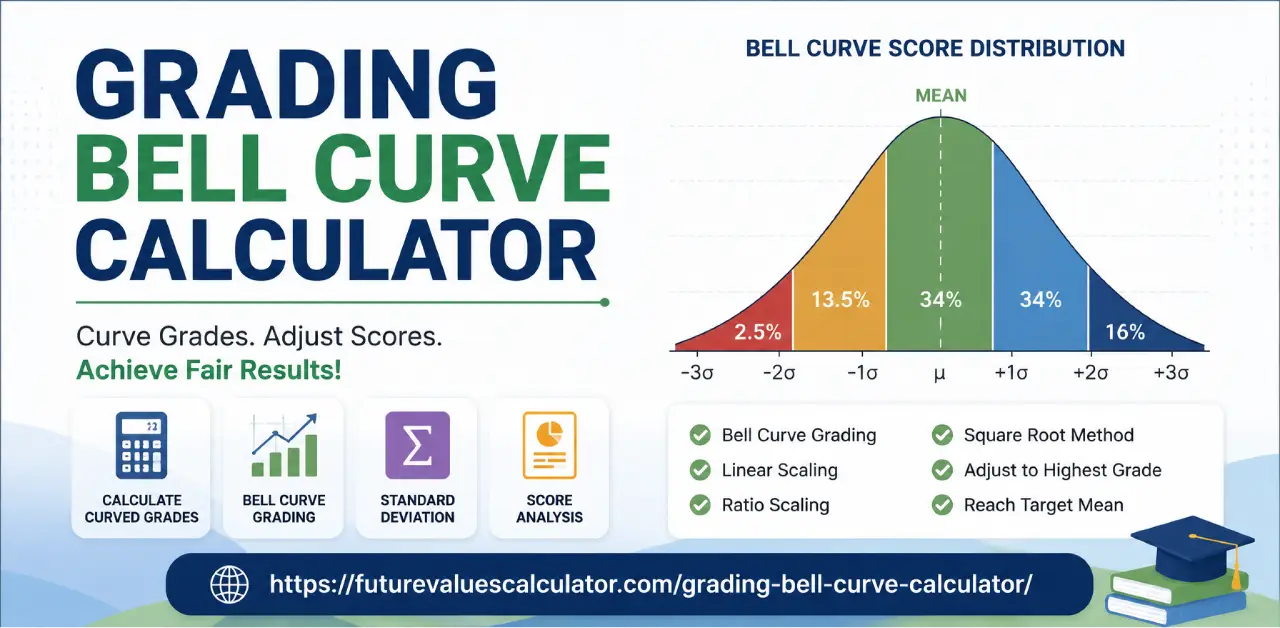
Grading Bell Curve Calculator: Calculate Curved Grades and Adjust Exam Scores Easily
A Grading Bell Curve Calculator helps teachers, professors, and students adjust exam scores using mathematical methods.
Grade Curve Calculator
Curved Results
76.3%
69.7
90 → 100
55 → 61.1
10
| # | Raw Score | Curved Score | Grade |
|---|
When an exam turns out to be harder than expected, many educators use a grading curve to make scores fairer. Instead of changing individual grades manually, the calculator applies formulas to the entire class and creates a balanced score distribution.
Today, schools and universities increasingly rely on a grade curve calculator, bell curve grading calculator, and exam curve calculator to improve fairness in assessment. Whether you want to calculate curved grades, understand bell curve grading, or learn how to calculate grades on a bell curve, this guide covers everything in simple language.
What Is a Grading Bell Curve Calculator?
A Grading Bell Curve Calculator is an online tool that adjusts student scores based on a selected grading method. It can raise low scores, shift the class average, or redistribute grades according to a statistical model. Many people searching what is a grading bell curve calculator want an easier way to convert raw marks into fairer grades.
This tool works as a curved grade calculator, grading curve calculator, and class curve calculator because it can process many student scores at once. Instead of spending hours in spreadsheets, teachers can quickly adjust test scores and create a better grade distribution for the class.
What Is Bell Curve Grading?
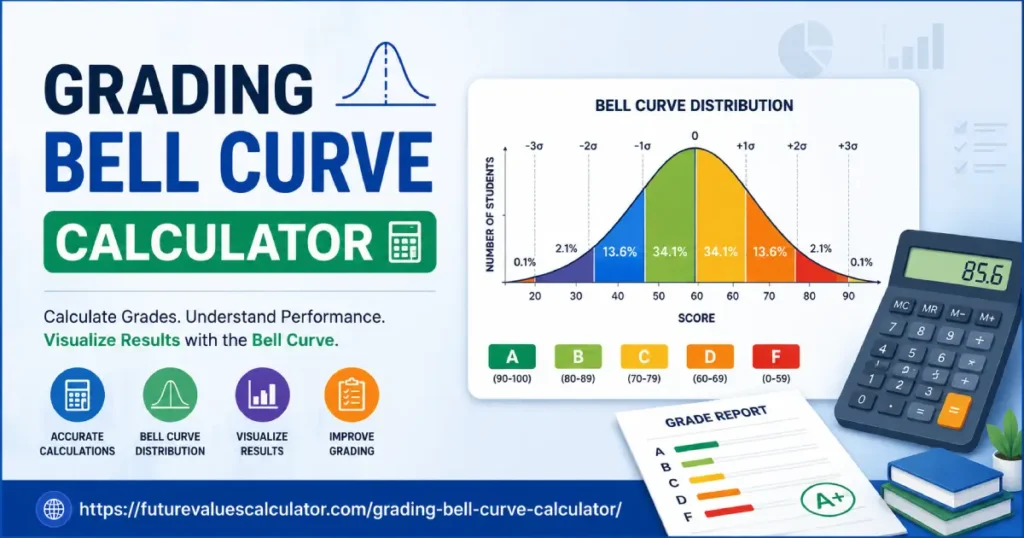
Bell curve grading is a method that places student scores into a pattern called a normal distribution. Most students receive grades near the middle while fewer students receive extremely high or low grades. This system is often used when an exam is unusually difficult.
Many people ask, what is bell curve grading in education and how does grading on a curve work. In simple words, the process compares each student’s performance to the rest of the class instead of using fixed percentages. This approach is widely used in colleges because it supports normal distribution grading and allows instructors to curve exam scores more fairly.
| Grade Group | Percentage of Students |
| Top Grades | 10% |
| Above Average | 20% |
| Average | 40% |
| Below Average | 20% |
| Lowest Grades | 10% |
How Does a Grading Bell Curve Calculator Work?
A bell curve score calculator begins by collecting all student marks. It then calculates the class average and measures how spread out the scores are. The calculator uses these values to create adjusted grades.
If you wonder how does a grading bell curve work, the answer lies in statistics. The calculator acts like a standard deviation calculator, class average calculator, and grade normalization calculator. It uses standard deviation grading to determine which students performed above or below the average and then creates an appropriate curved score percentage.
How to Use the Grading Bell Curve Calculator
Using a free grading bell curve calculator is simple. Enter the exam scores, select a grading method, and click calculate. The tool instantly shows original and curved grades.
People searching how to use a grade curve calculator or how to calculate curved exam scores often prefer an online grade curve calculator because it removes manual calculations. A test score curve calculator free version can save a significant amount of time during grading season.
| Step | Action |
| 1 | Enter student scores |
| 2 | Select a curve method |
| 3 | Choose target average |
| 4 | Calculate results |
| 5 | Review curved grades |
Formula Used in Bell Curve Grading
The mathematical formulas behind bell curve grading are surprisingly straightforward. The first formula calculates the average score.
Mean Formula
Mean = Sum of Scores ÷ Number of Students
The second formula measures score variation.
Standard Deviation = √[Σ(x−μ)²/N]
The third formula calculates the student’s position in the class.
Z-Score = (X−μ)/σ
These formulas power every grading percentage calculator, exam score calculator, and bell curve percentage calculator. They make grade normalization possible and help teachers rescale grades accurately.
Different Methods of Curving Grades
Not every teacher uses the same curve. A grade scaling calculator may offer several options, including linear scaling, ratio scaling, bell curve grading, and square root grading.
Many educators searching how to curve grades using standard deviation choose the bell curve method because it follows statistical principles. Others prefer simpler score scaling methods such as adding fixed points or increasing the class average. A score adjustment calculator and grade rescaling calculator usually support multiple approaches.
| Method | Description |
| Bell Curve | Uses average and standard deviation |
| Linear Scaling | Raises scores equally |
| Ratio Scaling | Multiplies scores by a factor |
| Square Root Curve | Helps lower-performing students |
| Fixed Points | Adds points to all grades |
Bell Curve Grading vs Linear Grade Scaling
Bell curve grading and linear scaling are often confused. However, they work differently. Bell curve grading adjusts scores according to class performance while linear scaling adds the same adjustment to everyone.
People often ask, what is the difference between bell curve and linear scaling. The answer is simple. A grade scaling calculator using linear methods treats all students equally. A bell curve score distribution calculator focuses on the relationship between scores and class performance.
| Feature | Bell Curve | Linear Scaling |
| Uses Average | Yes | No |
| Uses Standard Deviation | Yes | No |
| Equal Adjustment | No | Yes |
| Best for Difficult Exams | Yes | Sometimes |
Example of a Grading Bell Curve Calculation
Imagine a class where the average score is 62 out of 100 because the exam was unusually hard. A professor uses a bell curve calculator for exam scores to increase the average to 75.
The following example shows how calculating curved grades works in practice.
| Student | Original Score | Curved Score |
| Anna | 55 | 66 |
| David | 62 | 74 |
| Sarah | 70 | 81 |
| Michael | 85 | 92 |
This example demonstrates how grades are adjusted on a curve and why many instructors use a class grading curve calculator.
Benefits of Using a Grading Bell Curve Calculator
A grading bell curve calculator can improve fairness in classrooms. It reduces the effect of unusually difficult exams and helps instructors maintain consistent standards.
Teachers also use this educational grading tool for class performance analysis and exam score adjustment. A grading calculator for teachers can process hundreds of scores in seconds. This saves time and produces more reliable grading decisions.
Drawbacks of Grading on a Curve
Although a curve can improve fairness, it isn’t perfect. Some students dislike the system because their grade depends partly on the performance of others.
Critics often ask, Is grading on a curve fair? The answer depends on the situation. In highly competitive classes, a curved grading system may create unnecessary pressure. It can also increase grades even when the overall class performance remains weak.
Who Should Use a Grading Bell Curve Calculator?
Teachers and professors are the primary users of a classroom bell curve calculator and curved grading calculator for professors. These tools help them manage large classes and maintain consistent grading standards.
Students also benefit from an academic grading calculator free because it allows them to estimate future grades and understand how grading adjustments work. Schools often use a grading scale calculator for schools and an exam grade normalization calculator for large standardized assessments.
Frequently Asked Questions About Grading Bell Curve Calculators
What is a grading bell curve?
A grading bell curve distributes scores around an average and creates a balanced grade pattern.
How do you calculate a bell curve for grades?
Calculate the mean, determine the standard deviation, and use a z-score formula to adjust grades.
Can grades be curved automatically?
Yes. An accurate grade curve calculator or score scaling calculator online can automate the entire process.
How do teachers curve exam scores?
Teachers may use bell curves, linear scaling, ratio scaling, or fixed-point methods.
What is a grade normalization calculator?
It is a tool that adjusts scores to create a more balanced and fair grading distribution.
How does square root grading work?
Square root grading increases lower scores more than higher scores, helping struggling students without significantly changing top performers.
Final Thoughts
A Grading Bell Curve Calculator is one of the most useful tools for modern education. It combines statistics and practical grading methods to create fairer results. Whether you need a grade curve calculator online, a bell curve statistics calculator, or an academic score calculator, understanding how grading curves work can help you make smarter decisions about exam results and classroom assessment.
By learning the formulas and methods behind grading on a curve, educators and students can better understand grades, improve transparency, and make assessments more meaningful.
Other important financial calculators
We provide free online calculators with easy explanations. Every calculator is tested using standard formulas and updated regularly to improve accuracy.
You can also use our best and free calculator tools like, Calculate loan repayments with our Loan EMI Calculator , CPC,CPM & CTR Calculator ,Construction Calculator,401k Calculator and Hourly to Salary Calculator, Pool Salt Calculator, Bench Press Calculator, Gematria Calculator , Future Property value calculator, 20 weeks from Today , Pine Straw Calculator , Grading Bell Curve Calculator, and Peptide calculator, Concrete Calculator ,Limestone Calculator, SIP Calculator and losertown calorie calculator etc. .