
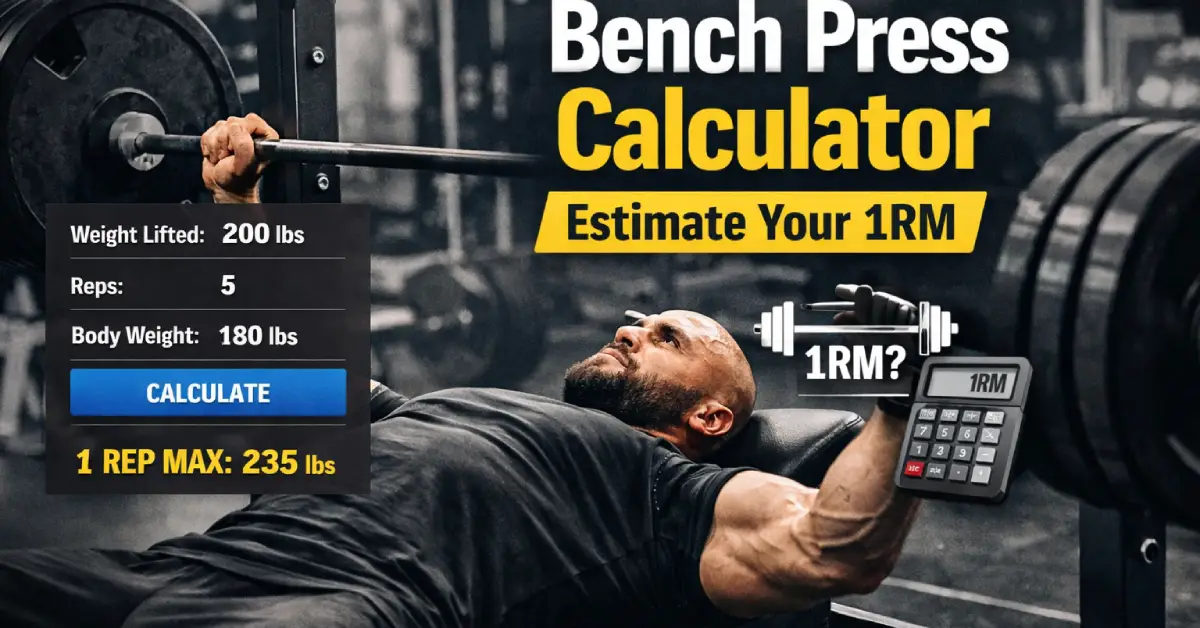
Bench Press Calculator: The Ultimate Tool for Strength Training
The bench press calculator helps you estimate your one rep max (1RM), which is the maximum weight you can lift for one repetition. Enter your Values to Calculate Bench Press.
Bench Press Calculator
Always free
Epley & Brzycki
Real-time results
Responsive
Estimated 1RM Strength
233 lbs
233 lbs
225 lbs
227 lbs
Working Weight Ratio
Formula Comparison
Percentage Training Matrix
| % 1RM | Weight | Est. Reps | Training Focus |
|---|
By using this tool, you can track your strength progress, set realistic goals, and improve your workouts. It’s a simple way to ensure you’re lifting the right weight for your fitness level. In the world of fitness and weight training, a Chest Press Calculator is a useful tool for checking and improving your strength. Whether you are a beginner or an advanced lifter, knowing your strength level helps you train better and reach your fitness goals faster. Tools like a one rep max calculator help you estimate the maximum weight you can lift for one repetition safely and accurately.
This strength assessment tool makes it easier to track your progress, plan workouts, and increase muscle strength over time. In this article, you will learn how the Chest Press Calculator works, its benefits, and the best ways to use it to improve your chest press performance and overall strength training results.
What is a max bench calculator and How Does It Work?
A Max Bench Calculator is a helpful tool that estimates your one rep max (1RM), which is the heaviest weight you can bench press for one repetition. You only need to enter the weight you lifted and the number of reps you completed. The calculator will then estimate your maximum bench press strength.
Knowing your 1RM helps you understand your current strength level and create a better strength training plan. It also helps you apply progressive overload, which is important for building muscle and increasing bench press performance.
The calculator uses trusted formulas like Epley, Brzycki, and Wathan to give an accurate estimate of your max bench press. These strength training formulas consider both the weight lifted and the number of repetitions performed. Using a bench press calculator can help you set realistic fitness goals, track workout progress, improve weightlifting performance, and reduce the risk of injury by avoiding overtraining.
How to Calculate Your One Rep Max (1RM) for Bench Press
Calculating your one rep max (1RM) is an essential part of any strength training program. It serves as a baseline to measure progress. To calculate your 1RM using a bench press strength calculator, simply input the weight lifted and the number of reps completed at that weight.
For instance, if you bench press 150 lbs for 5 reps, a Press max estimator will estimate your 1RM bench press. The formula used can be as simple as:
1RM = Weight × (1 + 0.0333 × Reps). This estimate will give you a starting point for setting goals and adjusting your workouts.
Factors Affecting Your Bench Press Strength and Performance
Many factors affect how much weight you can lift in the bench press. These include your body weight, muscle mass, training experience, diet, and workout routine. People with more muscle mass and higher body weight often have greater bench press strength and lifting power.
Your bench press technique is also very important. Using proper form helps activate the right chest, shoulder, and arm muscles, which improves strength and performance. Good lifting technique also lowers the risk of injury during strength training.
Training consistency plays a big role in muscle growth and strength gains. If you skip workouts often or do not follow a proper nutrition plan, your progress may slow down. Eating enough protein, healthy carbs, and calories helps support muscle recovery and powerlifting performance.
Rest and recovery are just as important as training. Overtraining can cause muscle fatigue, lower energy levels, and reduced workout performance. Getting enough sleep and recovery time helps your muscles grow stronger and improves your overall bench press results.
Benefits of Using a bench max calculator for Strength Training
Using a One-rep max calculator can help you track your progress and set more realistic goals. By regularly inputting your weights and reps, you can assess how much you’ve improved over time. This is crucial for understanding your strength training progress.
Moreover, a fitness calculator for bench press allows you to safely increase the weight you lift, reducing the risk of injury. By knowing your 1RM, you can better plan your training sessions, ensuring you’re lifting within your limits while steadily improving. Regular use of this tool boosts motivation as you see tangible improvements in your performance.
Understanding 1rm calculator
Results: What Do They Mean?
When you use a Max lift tracker, the results represent an estimate of your maximum strength. However, it’s essential to understand that these results are based on formulas and may not be 100% accurate, especially if your form isn’t perfect or if you’re lifting in a fatigued state.
The calculator gives you an idea of your max bench press estimation, but your actual capacity might be different depending on your physical condition. The goal is not to obsess over the numbers but to use them as a guideline for progressing in your strength training routine.
How Accurate Are bench max calculator?
Weightlifting calculator can provide fairly accurate estimates, but they aren’t always perfect. Factors like bodyweight, age, and the number of reps can affect the calculation. For example, someone new to strength training might find the calculator’s estimates slightly inaccurate because their neuromuscular adaptations haven’t fully developed.
That said, these calculators still offer great insight for tracking progress over time. The more consistent you are with your training, the more reliable your 1RM bench press estimate will become.
Common Bench Press Calculating Formulas Explained
Several formulas are commonly used by Strength assessment tool to estimate a lifter’s maximum strength. These include:
- Epley Formula: 1RM = Weight × (1 + 0.0333 × Reps)
- Brzycki Formula: 1RM = Weight × (36 / (37 – Reps))
- Wathan Formula: 1RM = Weight × (1 + 0.025 × Reps)
Each formula offers different accuracy levels, depending on your training experience and the number of reps you’re lifting. Some might work better for powerlifting while others are ideal for bodyweight bench press estimates.
Bench Press Progression: How to Use the Calculator to Track Your Gains
Tracking your bench press gains over time is essential for growth. By using a Strength training calculator regularly, you can see where your strength is improving and where you need to focus more effort. This helps you adapt your training program and gradually increase your weights.
One of the key benefits of a rep max calculation for bench press is that it helps identify your weaknesses. If your calculator estimate suggests a higher 1RM than you can actually lift, it’s an indication that your form or technique might need attention.
The Role of Body Weight in Bench Press Calculations
Body weight plays a significant role in your bench press strength. The heavier you are, the more muscle mass you generally carry, which leads to a greater potential for lifting heavier weights. A Workout calculator can take this into account, offering a more personalized estimate based on your weight.
For example, lighter individuals may not be able to lift as much as heavier lifters due to muscle mass differences. However, this doesn’t mean you can’t improve. By using a fitness calculator for bench press, you can track your progress and set realistic goals based on your body weight.
Best bench press max tool Online: Our Top Picks
There are several Bench press tool available online, but not all are created equal. Some offer advanced features, while others focus purely on simplicity. Here are a few top picks:
- StrengthLevel.com: Known for accuracy, it uses multiple formulas and provides progress tracking.
- ExRx.net: Offers a powerlifting Bench press tool and various fitness tools.
- MyFitnessPal: This app integrates nutrition and exercise, including strength calculators.
These calculators provide insights not only into your max bench press but also how you compare to other lifters of similar weight and experience levels.
How to Improve Your Bench Press Using Calculator Data
To improve your bench press numbers using a calculator, focus on progressively increasing your weights based on your 1RM data. The calculator allows you to adjust your training load effectively, ensuring you’re challenging your muscles without risking injury.
Start with a manageable percentage of your 1RM bench press, and over time, gradually increase the weight as your strength improves. This approach, known as progressive overload, is key to building strength efficiently.
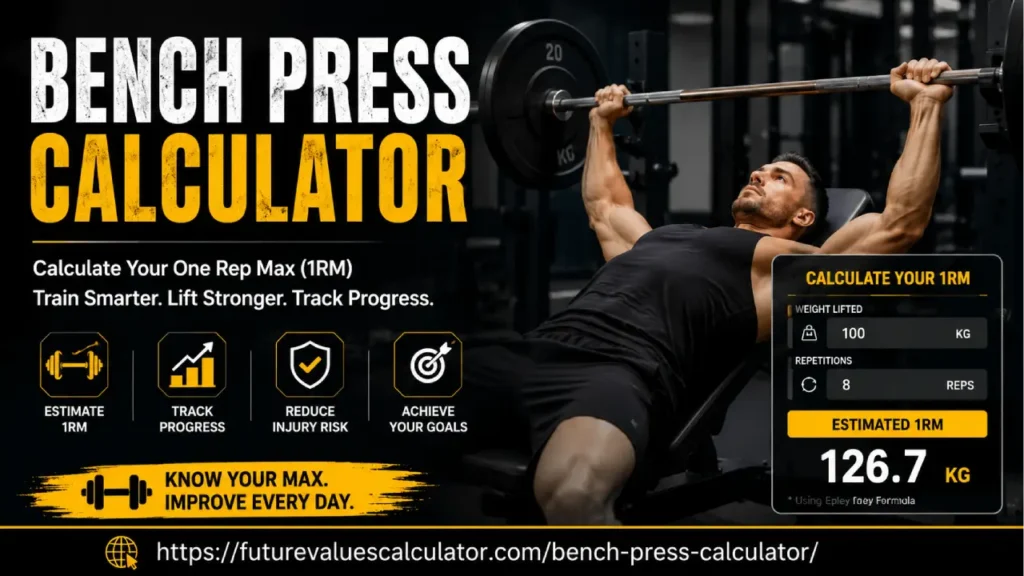
Why Consistency Matters: Tracking One-rep max with a Calculator Over Time
The key to success with any strength training program is consistency. Using a One-rep max calculator consistently helps you monitor your progress and avoid hitting plateaus. By tracking your bench press gains regularly, you can make informed decisions about your training program.
Moreover, consistency allows you to measure improvements accurately, adjusting your goals based on the data. A One-rep max calculator becomes a powerful tool when used regularly to fine-tune your training strategy.
Using the 1 RM to Set Realistic Fitness Goals
When you use a workout calculator, it can help you make realistic goals. For example, if the calculator says your max bench press is 200 lbs, you could try to reach 220 lbs in six months.
Making goals this way helps you get stronger safely. It keeps you motivated and focused without hurting yourself or getting too tired.
Mistakes to Avoid When Using a One-rep max calculator
A one-rep max calculator can help you, but you need to be careful. One mistake is thinking you can lift more than you really can. Another mistake is not using the right form when lifting heavy weights.
Knowing these mistakes can help you avoid them and get stronger safely. Use the calculator as a guide, not the exact number. This way, your training stays safe and effective.
What to Do When Your Bench Press Numbers Don’t Add Up
Sometimes, the numbers from your max bench calculator might not match what you can actually lift. That’s okay! Things like tired muscles, not eating well, or wrong form can change your strength.
If this happens, check your training plan. Make sure you rest enough, eat healthy, and practice good technique. Remember, the calculator only gives an estimate. It doesn’t show your full strength.
Conclusion
Using a fitness calculator often can help you get stronger. It shows your one-rep max (the most weight you can lift once) and helps you track your progress. You can change your training based on the results. This tool helps you lift more and improve your bench press safely and easily.
FAQs
Q1. How much should a 65-year-old man bench press?
It varies, but a 65-year-old man should aim to bench press around 70-100% of their body weight, depending on fitness level and health.
Q2. How much should I bench press according to my weight?
A good starting point is to bench press your body weight or slightly more if you’re an experienced lifter. Beginners should start with lighter weights and increase gradually.
Q3. How rare is a 300 lb bench press?
A 300 lb bench press is rare, especially for non-professional lifters, and typically requires significant strength training and dedication.
Q4. What is my bench max if I can do 135 for 10?
If you can bench press 135 lbs for 10 reps, your estimated one rep max (1RM) is around 170-185 lbs, depending on your technique and fatigue.
Q5. What is Shaq’s Max bench press?
Shaquille O’Neal’s max bench press is reported to be around 475 lbs, showcasing his impressive strength.
Q6. How rare is benching 225 for 10 reps?
Benching 225 lbs for 10 reps is rare and considered an impressive feat, even among experienced lifters. It requires a strong upper body and chest strength.
Use Our other Free Calculator’s
We provide free online calculators with easy explanations. Every calculator is tested using standard formulas and updated regularly to improve accuracy.
You can also use our Free Calculators like, Future Value Calculator, Loan EMI calculator, CPM, CPC & CTR Calculator, 401k Calculator, Construction Calculator, Hourly to Salary Calculator, Property Value Calculator , losertown calorie calculator , Limestone Calculator Gematria Calculator, Peptide Calculator, 20 weeks from today calculator, Pine Star Calculator, Grading bell Curve Calculator and Pool Salt Calculator.