

SIP Calculator – Calculate Your SIP Returns with Our Free Systematic Investment Plan Calculator
A SIP Calculator helps you estimate how your money may grow over time through regular investments.
SIP Calculator
Always free
Standard SIP
Fast results
Responsive
Expected Wealth
Rs 1,161,695.38
Rs 600,000.00
Rs 561,695.38
1.94x
Investment Split
Yearly Growth Chart
Yearly Schedule
| Yr | Monthly SIP | Invested | Returns | Total Value |
|---|
Investing doesn’t have to feel confusing or risky. A SIP Calculator helps you estimate how your money may grow over time through regular investments. Instead of making rough guesses, you can see an estimated Future Value based on your monthly contribution, expected return, and investment period. Whether you’re saving for retirement, a child’s education, a home, or long-term Wealth Creation, this tool makes Financial Planning easier and more practical.
A Systematic Investment Plan Calculator works well for both beginners and experienced investors because it simplifies complex calculations within seconds. Rather than calculating Compound Interest manually, you receive an instant estimate of your Maturity Value, Estimated Returns, and Total Investment. This guide explains everything you need to know, including What is a SIP Calculator?, How does a SIP Calculator work?, the calculation formula, and practical examples that help you make informed investment decisions.
What Is a SIP Calculator?
A SIP Calculator is a simple online tool that helps you estimate how much your money can grow over time. You do not need to do difficult math. Just enter your monthly investment amount, the expected yearly return, and the investment period. The calculator quickly shows an estimate of your future savings by using the power of compounding. It also helps you compare different investment plans before you invest.
A Systematic Investment Plan (SIP) Calculator is different from a regular savings calculator because it works with monthly investments instead of a one-time deposit. It also estimates how your money may grow over time. Many people use tools such as a Mutual Fund SIP Calculator, SIP Investment Calculator, Monthly SIP Calculator, SIP Return Calculator, SIP Interest Calculator, SIP Growth Calculator, and SIP Maturity Calculator to plan their investments. While the results are only estimates and not guaranteed, they can help you make better investment decisions and plan for your financial future.
Who Should Use This Calculator?
A SIP calculator benefits almost everyone who wants to invest regularly. Beginners can understand how consistent investing builds wealth, while experienced investors can compare different investment periods and expected returns before adjusting their portfolios.
It is particularly helpful for people planning Retirement Planning, Child Education Planning, emergency savings, or long-term Financial Independence. Since investing is a long journey, calculating expected outcomes before investing can help you stay focused on your financial goals.
How Does a SIP Calculator Work?
Understanding How does a SIP Calculator work? is easier than many people think. Every month, you invest a fixed amount into a mutual fund. Each monthly contribution earns returns over time. Those returns then begin earning additional returns through Compounding, allowing your investment to grow faster as the years pass.
The SIP Calculator estimates this growth using your monthly contribution, expected annual return, and total investment period. A longer investment duration generally produces significantly larger returns because each investment remains invested for more time. This illustrates why patience often plays a greater role than investing larger amounts for shorter periods.
How Monthly Investments Grow
Each monthly investment purchases units based on the current NAV of the selected Mutual Funds. When markets fluctuate, you automatically buy more units at lower prices and fewer units at higher prices. This investing approach is known as Rupee Cost Averaging, helping reduce the impact of short-term market volatility.
As your investments continue growing, every month’s contribution benefits from the Power of Compounding. Over long periods, this creates substantial Portfolio Growth, even if monthly contributions remain relatively modest.
Why Investment Duration Matters
Time is often the most valuable factor in investing. A person investing for 25 years usually accumulates much more wealth than someone investing twice as much for only 10 years. Longer investment periods allow returns to compound repeatedly, creating exponential rather than linear growth.
This is why financial experts often recommend starting early instead of waiting until your income increases. Even a small monthly investment can become significant over decades.
SIP Calculator Formula with Simple Explanation
Many investors ask, What is the formula for SIP calculation? While the calculation may appear complicated, the idea behind it is simple. Every monthly investment earns returns until the investment period ends, creating a steadily growing investment corpus.
The commonly used SIP formula is:
Where:
| Symbol | Meaning |
| FV | Future Value of your investment |
| P | Monthly investment amount |
| r | Monthly rate of return |
| n | Total number of monthly investments |
This formula estimates your future corpus based on recurring investments and expected growth. Fortunately, an Online SIP Calculator performs these calculations instantly, so you don’t need to calculate them manually.
Understanding Each Variable
Your Investment Amount determines how much money enters the investment every month. The Expected Annual Return represents the average yearly growth you anticipate based on historical Market Returns. Your Investment Duration determines how long your money remains invested.
Although the formula assumes consistent returns, real-world investments fluctuate because markets rise and fall. Therefore, a calculator provides an estimate rather than an exact prediction.
Why Manual Calculations Are Difficult
Many people ask, Can I calculate SIP manually? Technically, yes. However, manual calculations become complicated once monthly contributions, compounding, and varying investment periods are included. Even small mistakes can significantly affect the final estimate.
A Monthly Investment Calculator, Wealth Calculator, or Long-Term Investment Calculator completes the same calculation within seconds while allowing you to compare multiple investment scenarios instantly.
How to Use This SIP Calculator
Using a SIP Calculator requires only a few simple steps. First, enter the amount you plan to invest every month. Next, choose your expected annual return based on your investment strategy. Then select your investment period and include a Step-Up SIP percentage if you plan to increase your monthly contribution each year. Finally, click the calculate button to view your results.
The results page generally displays your Total Investment, estimated profit, and projected Maturity Value using easy-to-read charts and graphs. Visual summaries help you understand how regular investing contributes to long-term Wealth Creation.
Step-by-Step Guide
| Step | Action |
| 1 | Enter your monthly investment amount |
| 2 | Select the expected annual return |
| 3 | Choose your investment tenure |
| 4 | Add Step-Up SIP if applicable |
| 5 | Click Calculate |
| 6 | Review your estimated future value |
Understanding the Results
After calculation, you’ll usually see three important figures. The first is your Total Investment, which shows the total money you contributed. The second is your Estimated Returns, representing projected investment growth. The final figure is your Maturity Value, which combines your contributions with estimated earnings.
If your calculator includes graphs, you’ll also see how your investment grows over time. These visual reports make Goal-Based Investing much easier to understand.
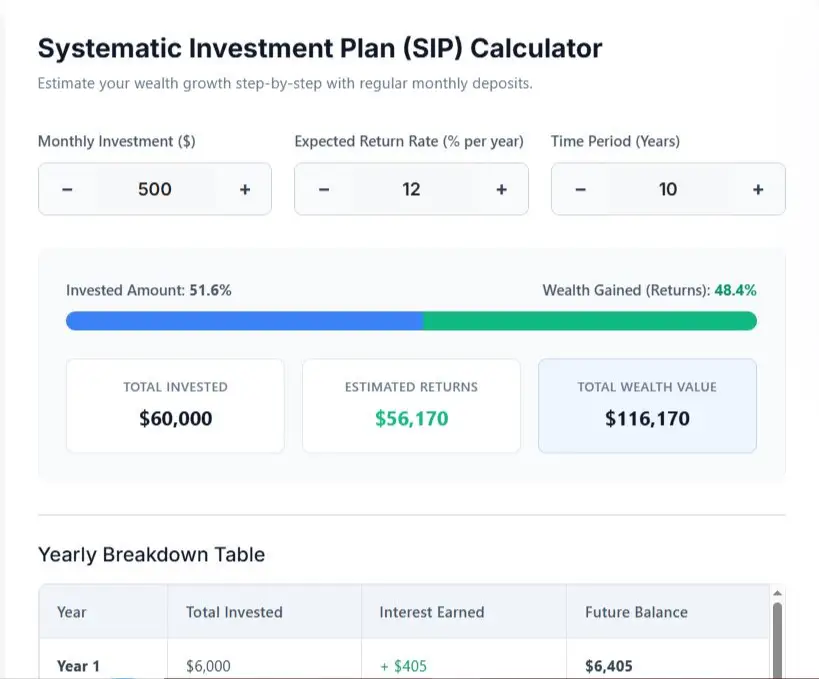
Information You Need Before Calculating SIP Returns
Accurate results depend on entering realistic information. Before using a SIP Calculator, understand each input because even small adjustments can significantly change your estimated future value. Investors should review their financial goals, expected returns, and investment timeline before making decisions.
Choosing realistic assumptions also helps avoid disappointment later. Markets don’t produce identical returns every year, so your calculator should be viewed as a planning tool rather than a promise of future performance.
Monthly Investment Amount
Your Monthly Investment is the fixed amount invested every month. Higher monthly contributions generally lead to larger wealth accumulation, although consistency often matters more than investing large sums occasionally.
Expected Annual Return
The Expected Rate of Return is your estimated yearly investment growth. Equity investments may deliver higher long-term returns than debt investments, although they also involve greater market risk.
Investment Period
Your Investment Tenure determines how long your money remains invested. Longer periods provide greater opportunities for compounding and wealth accumulation.
Step-Up SIP (Optional)
A Step-Up SIP allows you to increase your monthly contribution every year. Even a small annual increase can substantially improve your future wealth without placing significant pressure on your current budget.
Compounding Frequency
Compounding determines how frequently investment earnings generate additional earnings. More frequent compounding generally produces higher long-term growth, making it one of the most powerful concepts in investing.
SIP Return Calculation Example
Understanding numbers becomes much easier when you look at real examples. A SIP Calculator estimates how your money may grow if you invest regularly over many years. The final amount depends on your Monthly Investment, Expected Rate of Return, Investment Tenure, and the Power of Compounding. The examples below assume an estimated annual return of 12%, which many investors use for long-term planning. Actual Market Returns may be higher or lower.
The examples below are only illustrations to help you understand How to calculate SIP returns? They should not be considered guaranteed investment results because mutual fund performance changes with market conditions. A SIP Return Calculator, SIP Value Calculator, or Mutual Fund Calculator provides estimates based on the information you enter.
| Monthly Investment | Investment Period | Expected Annual Return | Total Investment | Estimated Maturity Value* |
| ₹5,000 | 10 Years | 12% | ₹6,00,000 | ~₹11.6 Lakhs |
| ₹10,000 | 20 Years | 12% | ₹24,00,000 | ~₹99.9 Lakhs |
| ₹20,000 | 25 Years | 12% | ₹60,00,000 | ~₹3.8 Crore |
*Estimated values are approximate and may vary depending on actual fund performance.
Example 1: ₹5,000 Monthly SIP
Imagine you invest ₹5,000 every month for 10 years. Your Total Investment would be ₹6,00,000. If the investment earns an average annual return of 12%, your estimated Future Value could grow to around ₹11.6 lakhs. This simple example shows how regular investing creates meaningful Investment Growth even with a modest contribution.
This example answers a common search query: SIP calculator for ₹5,000 per month. Many first-time investors begin with this amount because it is affordable while still allowing them to build healthy investing habits over time.
Example 2: ₹10,000 Monthly SIP
Now consider investing ₹10,000 every month for 20 years. Your total contribution becomes ₹24 lakhs. Thanks to Compound Interest, your estimated portfolio may approach ₹1 crore if the expected return averages around 12% annually.
This example highlights why financial advisors encourage Long-Term Investment instead of trying to time the market. The extra years often contribute more to wealth than simply increasing your monthly investment.
Example 3: ₹20,000 Monthly SIP
An investor contributing ₹20,000 every month for 25 years invests a total of ₹60 lakhs. With consistent investing and an average annual return of 12%, the projected Maturity Value may exceed ₹3.8 crore.
This demonstrates the remarkable effect of Portfolio Growth over long periods. It also answers popular searches such as SIP calculator for ₹20,000 per month, SIP calculator for 25 years, and Future value SIP calculator.
Case Study: Two friends begin investing at different ages. Sarah starts investing ₹8,000 per month at age 25, while David starts the same amount at age 35. Even if both earn similar returns, Sarah is likely to accumulate substantially more wealth because her investments enjoy an additional decade of compounding. Time often becomes the greatest wealth-building asset.
Benefits of Using a SIP Calculator
A SIP Calculator offers far more than quick calculations. It gives you a clearer picture of your financial future by estimating how regular investments may grow over time. Instead of relying on assumptions, you receive structured estimates that support better Investment Planning and realistic goal setting.
Using a Systematic Investment Plan Calculator also helps remove emotions from investment decisions. Rather than reacting to short-term market movements, you can focus on consistent investing and long-term financial growth.
Key Benefits at a Glance
| Benefit | Why It Matters |
| Saves Time | Instant calculations without manual formulas |
| Accurate Estimates | Reduces human calculation errors |
| Better Financial Planning | Helps set realistic financial goals |
| Goal-Based Investing | Plans investments around life goals |
| Scenario Comparison | Compare different investment amounts and durations |
Saves Valuable Time
Manual calculations require formulas, spreadsheets, and repeated adjustments. A Monthly SIP Calculator produces results instantly, allowing you to compare multiple investment plans within minutes.
Time saved on calculations means you can spend more effort researching suitable Mutual Funds, reviewing your Investment Strategy, and improving your overall financial plan.
Provides Accurate Estimates
Although future returns cannot be guaranteed, calculators apply consistent mathematical formulas that reduce calculation mistakes. Whether you use a SIP Interest Calculator, Investment Planning Tool, or Compound Interest Calculator, the calculations remain reliable based on your assumptions.
Accurate estimates help investors understand the relationship between monthly contributions, investment duration, and projected returns.
Supports Better Financial Planning
A well-designed Financial Planning Calculator transforms abstract goals into measurable targets. Instead of saying you want financial security someday, you can estimate how much monthly investing may help achieve that goal.
This approach works especially well for Retirement Planning, buying a home, emergency savings, or funding higher education.
Encourages Goal-Based Investing
Successful investing begins with clear objectives. A Goal Planning Calculator helps estimate the monthly contribution needed for specific milestones instead of investing without direction.
Whether your goal is Child Education Planning, retirement, or building long-term wealth, structured planning increases your chances of staying disciplined.
Makes Comparing Scenarios Easy
One of the biggest advantages of an Investment Return Calculator is flexibility. You can compare different contribution amounts, expected returns, investment periods, or annual increases within seconds.
For example, increasing your monthly contribution by just ₹2,000 may dramatically improve your projected future wealth over twenty years.
SIP vs Lump Sum Investment: Which Is Better?
One of the most searched investment questions is SIP vs Lump Sum investment. Both strategies have advantages, but the better option depends on your financial situation, investment experience, and available capital. A SIP Calculator can help compare both approaches before making a decision.
A lump sum investment places all your money into the market at one time. A SIP spreads your investment over months or years, reducing the impact of market volatility through regular investing.
| Feature | SIP Investment | Lump Sum Investment |
| Investment Style | Monthly investing | One-time investing |
| Risk | Lower timing risk | Higher timing risk |
| Market Timing | Less important | More important |
| Suitable Investors | Most beginners | Experienced investors |
| Cash Requirement | Small monthly amount | Large upfront amount |
| Flexibility | High | Moderate |
When SIP Is a Better Choice
A SIP generally works better for investors with regular monthly income. It encourages disciplined investing while reducing emotional decision-making during market ups and downs.
The strategy also benefits investors who prefer gradual Wealth Creation without needing a large amount of money immediately.
When Lump Sum May Be Better
A lump sum investment may suit investors who already have substantial savings and believe current market conditions present attractive long-term opportunities.
However, investing a large amount at the wrong time may expose the portfolio to greater short-term market fluctuations.
Can You Combine Both?
Yes. Many experienced investors combine both strategies. They invest regularly through SIPs while adding lump sum investments whenever they receive bonuses, tax refunds, or other unexpected income.
This balanced approach allows investors to benefit from consistent investing while taking advantage of special opportunities.
Factors That Affect SIP Returns
Every SIP Calculator estimates future wealth using several important variables. Changing just one input may significantly increase or decrease your projected Estimated Returns. Understanding these factors helps you make better investment decisions instead of relying solely on market performance.
Although historical returns provide useful guidance, future performance depends on economic conditions, fund management, inflation, and investor discipline.
Major Factors Influencing SIP Returns
| Factor | Effect on Returns |
| Monthly Contribution | Higher investment usually creates larger wealth |
| Investment Duration | Longer periods increase compounding |
| Expected Return | Higher returns increase future value |
| Market Performance | Affects overall fund growth |
| Inflation | Reduces purchasing power |
| Step-Up SIP | Accelerates wealth accumulation |
Monthly Contribution
Increasing your monthly contribution gradually strengthens long-term wealth accumulation. Even modest increases each year may produce surprisingly large differences after twenty or thirty years.
Investment Duration
Time remains one of the strongest drivers of investment success. Longer investment periods allow returns to compound repeatedly, producing exponential rather than linear growth.
Expected Rate of Return
The Annual Return Rate determines how quickly your investments may grow. While higher expected returns increase projected wealth, investors should always use realistic assumptions.
Market Performance
Since SIP investments are market-linked, short-term fluctuations are normal. Consistent investing helps smooth these fluctuations through Rupee Cost Averaging, reducing the impact of market timing.
Inflation
Many investors overlook Inflation, yet it directly affects purchasing power. An investment growing at 8% may appear attractive, but if inflation averages 5%, the real growth becomes much smaller.
Some investors therefore search for a SIP Calculator with inflation to estimate future purchasing power rather than only nominal returns.
Step-Up Investments
A Step-Up SIP increases your monthly contribution every year, usually by 5% to 15%. This simple strategy allows your investments to grow alongside your income, significantly increasing long-term wealth without dramatically affecting your monthly budget.
Advantages and Limitations of a SIP Calculator
A SIP Calculator serves as an excellent planning tool, but understanding both its strengths and limitations creates more realistic expectations. Wise investors use calculators as guides rather than predictions.
Financial planning becomes more effective when estimates are combined with regular portfolio reviews and sensible investment decisions.
| Advantages | Limitations |
| Fast calculations | Results are estimates only |
| Easy to use | Cannot predict future markets |
| Free online access | Doesn’t guarantee returns |
| Supports financial planning | May not include taxes automatically |
| Helps compare investment scenarios | Assumes consistent growth |
Advantages
A Systematic Investment Plan Calculator saves time, simplifies planning, improves financial awareness, and encourages disciplined investing. It also allows investors to compare different scenarios before committing money, making investment decisions more informed and objective.
For beginners, these tools remove much of the complexity surrounding investment calculations, allowing them to focus on building healthy long-term investing habits.
Limitations
No calculator can accurately predict future Market Performance because investment returns fluctuate every year. Economic conditions, global events, inflation, and fund performance all influence actual investment results.
For this reason, every estimate should be treated as a planning guide rather than a guaranteed outcome. Reviewing your Investment Portfolio regularly remains essential for achieving long-term financial success.
Common Mistakes to Avoid When Investing Through SIP
Building wealth through a SIP Calculator is not only about choosing the right mutual fund. Your investment habits play an equally important role. Many investors earn lower-than-expected SIP Returns because they make avoidable mistakes instead of following a disciplined investment strategy. Understanding these common errors can help you protect your money and improve your long-term financial results.
A Systematic Investment Plan rewards patience, consistency, and realistic expectations. Markets naturally move up and down, yet investors who stay focused on their long-term Financial Goals often benefit more from the Power of Compounding than those who frequently change their investment decisions.
Investing for Too Short a Period
One of the biggest mistakes is expecting impressive returns within just a few years. A Long-Term Investment gives your money enough time to grow through Compound Interest and market recovery cycles. Investors who stop too early often miss the strongest years of portfolio growth.
If you use a SIP Calculator for 5 years, the estimated wealth may appear modest compared with a SIP Calculator for 20 years or SIP Calculator for 30 years. Time is one of the most powerful factors in Wealth Creation, which is why experienced investors encourage staying invested for longer periods whenever possible.
Stopping SIP During Market Falls
Market declines can make investors nervous, but stopping your SIP during a downturn often becomes an expensive mistake. Falling markets allow your Monthly Investment to purchase more units at lower prices through Rupee Cost Averaging. When markets recover, those additional units may contribute significantly to your overall portfolio growth.
Many people search “Is SIP safe for beginners?” because they worry about market volatility. While no market-linked investment is completely risk-free, continuing your SIP during market corrections has historically helped long-term investors benefit from future recoveries instead of locking in losses.
Ignoring Inflation
Many investors focus only on the final investment value without considering Inflation. Although your portfolio may grow steadily, rising living costs reduce your purchasing power over time. Planning without inflation can leave you with less money than you actually need to achieve your financial goals.
This is why many financial experts recommend using a SIP Calculator with inflation or comparing your estimates with an Inflation Calculator. Doing so provides a more realistic picture of your future financial position and helps you set practical investment targets.
Expecting Unrealistic Returns
Another common mistake is assuming every investment will generate exceptionally high returns year after year. While some Equity Mutual Fund investments have delivered excellent long-term performance, future Market Returns are never guaranteed. Building your financial plan around unrealistic expectations may lead to disappointment and poor investment decisions.
Instead, use reasonable assumptions when entering the Expected Annual Return in your SIP Investment Calculator. Conservative estimates often produce more reliable financial plans than overly optimistic projections.
Choosing Funds Without Research
Selecting a mutual fund simply because it performed well recently can create unnecessary risk. Every fund has a different investment strategy, risk level, expense ratio, and management approach. Understanding whether a fund is an Equity Mutual Fund, Debt Mutual Fund, Hybrid Mutual Fund, or ELSS Fund helps you choose investments that match your financial objectives.
Before investing, review the fund’s historical performance, risk profile, portfolio composition, and the reputation of the Asset Management Company (AMC). Good research doesn’t guarantee success, but it helps you make informed decisions.
Not Reviewing Your Portfolio Regularly
Although SIP investing encourages long-term discipline, that doesn’t mean you should ignore your investments completely. Your income, financial goals, and risk tolerance may change over time. Reviewing your Investment Portfolio once or twice a year helps ensure your investments still align with your long-term objectives.
Regular reviews also give you the opportunity to increase your contribution through a Step-Up SIP, rebalance your portfolio, or replace consistently underperforming funds when necessary.
Common SIP Mistakes at a Glance
| Mistake | Possible Impact | Better Approach |
| Investing for a short period | Lower wealth accumulation | Stay invested for the long term |
| Stopping during market falls | Miss recovery opportunities | Continue investing consistently |
| Ignoring inflation | Lower real purchasing power | Plan with inflation in mind |
| Expecting guaranteed returns | Unrealistic financial planning | Use practical return assumptions |
| Investing without research | Higher investment risk | Compare funds carefully |
| Never reviewing investments | Goals may become outdated | Review your portfolio annually |
Tips to Maximize Your SIP Returns
A SIP Calculator estimates how your investments may grow, but achieving better results depends largely on your investment discipline. Small improvements in your strategy can create significant differences over many years. Following proven investing principles helps you build wealth steadily while reducing unnecessary mistakes.
Successful investing rarely depends on finding the perfect mutual fund. Instead, it comes from consistency, patience, and making thoughtful decisions based on long-term objectives rather than short-term market movements.
Start Investing as Early as Possible
Time is the greatest advantage any investor can have. The earlier you begin investing, the more opportunities your money has to benefit from the Power of Compounding. Even small monthly investments started early may outperform much larger investments started years later.
This principle answers a common search query: Can SIP make me a millionaire? While no investment guarantees millionaire status, starting early and remaining consistent greatly improves your chances of building substantial long-term wealth.
Invest Every Month Without Missing Contributions
Consistency is one of the foundations of successful SIP Investment. Regular monthly investing builds discipline and allows you to benefit from market fluctuations through systematic investing. Missing contributions frequently can reduce your final Maturity Value and slow your financial progress.
Treat your SIP like any other important monthly expense. Automating your investments helps maintain consistency without requiring constant attention.
Increase Your SIP Every Year
As your salary or business income grows, consider increasing your investment amount through a Step-Up SIP. Even a small annual increase of 5% to 10% can dramatically improve your estimated future wealth over twenty or thirty years.
Many investors search for a SIP Calculator with yearly increase because they want to understand how gradual contribution increases affect long-term returns. In many cases, the improvement is surprisingly significant.
Stay Invested for the Long Term
Short-term market movements often distract investors from their long-term objectives. However, history has shown that markets generally reward patient investors over extended periods despite temporary fluctuations.
Whether your goal is Retirement Planning, Child Education Planning, or Financial Independence, staying invested allows your portfolio to recover from market declines and continue compounding over time.
Build a Diversified Investment Portfolio
Placing all your money into a single investment increases risk. Diversifying across different Mutual Funds, sectors, and asset classes helps reduce the impact of poor performance in any one investment.
A balanced portfolio may include equity funds for growth, debt funds for stability, and hybrid funds for a combination of both. Diversification supports better Risk Management while maintaining opportunities for long-term growth.
Review Your Investments Periodically
Investment planning is an ongoing process rather than a one-time decision. Reviewing your portfolio every six to twelve months allows you to assess fund performance, update your financial goals, and make adjustments when necessary.
During each review, compare your current investment progress with your original financial plan. If your income has increased, consider raising your monthly contribution or adding another SIP to strengthen your long-term investment strategy.
Match SIP Goals with Life Goals
Your investments should always support a specific purpose. Instead of investing without direction, connect each SIP to a meaningful objective such as buying a house, funding higher education, creating an emergency fund, or building retirement income.
This approach, often called Goal-Based Investing, keeps you motivated during market volatility because every contribution brings you closer to a clearly defined financial milestone.
Tips for Better SIP Performance
| Best Practice | Benefit |
| Start investing early | Maximizes compound growth |
| Invest consistently every month | Builds disciplined investing habits |
| Increase SIP annually | Accelerates wealth accumulation |
| Stay invested for many years | Improves long-term returns |
| Diversify your investments | Reduces overall portfolio risk |
| Review your portfolio regularly | Keeps investments aligned with your goals |
| Invest with clear objectives | Supports effective financial planning |
Expert Insight: A successful SIP is rarely built by chasing the highest-performing fund each year. It is built through consistent investing, realistic expectations, disciplined portfolio management, and allowing time to work in your favor. Patience often delivers stronger results than frequent buying and selling.
FAQs
What is a SIP Calculator?
A SIP Calculator is a free online tool that estimates how much your monthly SIP investment may grow over time.
How does a SIP Calculator work?
It uses your monthly investment, expected return, and investment period to calculate your estimated future value.
How to calculate SIP returns?
Enter your monthly SIP amount, expected annual return, and investment period. The calculator shows your estimated returns instantly.
What is the formula for SIP calculation?
A SIP calculator uses the future value formula to estimate your investment growth through compounding.
How much should I invest in SIP every month?
Invest an amount that fits your budget and financial goals. Even a small monthly SIP can grow over time.
What is the minimum SIP amount?
Most mutual funds allow you to start a SIP with as little as ₹500 per month.
Can SIP make me a millionaire?
Yes, investing regularly for many years can help you build significant wealth, but returns are not guaranteed.
Is SIP safe for beginners?
Yes, SIP is beginner-friendly because you invest a fixed amount every month instead of investing a large sum at once.
Is SIP risk-free?
No. SIP invests in mutual funds, so returns depend on market performance and can go up or down.
Does SIP guarantee returns?
No, SIP does not guarantee returns because mutual funds are linked to the market.
What is a good return on SIP?
A long-term SIP in equity mutual funds has historically earned around 10% to 15% annually, but actual returns vary.
Which SIP gives the highest return?
There is no single SIP that always gives the highest return. Choose a fund based on your goals and risk level.
Which is better, SIP or FD?
SIP offers higher long-term growth potential, while a Fixed Deposit provides stable but lower guaranteed returns.
What is the difference between SIP and mutual funds?
A mutual fund is the investment, while SIP is the method of investing in that mutual fund every month.
Can I change my SIP amount?
Yes, you can increase or decrease your SIP amount based on your financial needs.
Can I stop SIP anytime?
Yes, you can stop your SIP whenever you want. Most fund houses do not charge a penalty.
Can I withdraw SIP before maturity?
Yes, you can withdraw your investment from most open-ended mutual funds, subject to fund rules.
What happens if I miss an SIP payment?
Missing one payment usually doesn’t cancel your SIP, but repeated missed payments may stop it.
How many SIPs can I have?
You can have as many SIPs as you want, depending on your financial goals and budget.
Which is the best online SIP Calculator?
The best Online SIP Calculator is one that is free, easy to use, and shows your total investment, estimated returns, and maturity value clearly.
Our Featured and other best Calculators
We provide free online calculators with easy explanations. Every calculator is tested using standard formulas and updated regularly to improve accuracy.
You can also use our Latest and Free Calculators like, Future Value Calculator, Loan EMI Calculator, CPM, CPC & CTR Calculator, 401k Calculator, Construction Calculator, Hourly to Salary Calculator and Property Value Calculator, Pool Salt Calculator, Bench Press Calculator , Gematria Calculator , Losertown Calorie Calculator , 20 weeks from today Calculator , Pine Straw Calculator , Grading Bell Curve Calculator and limestone calculator .