
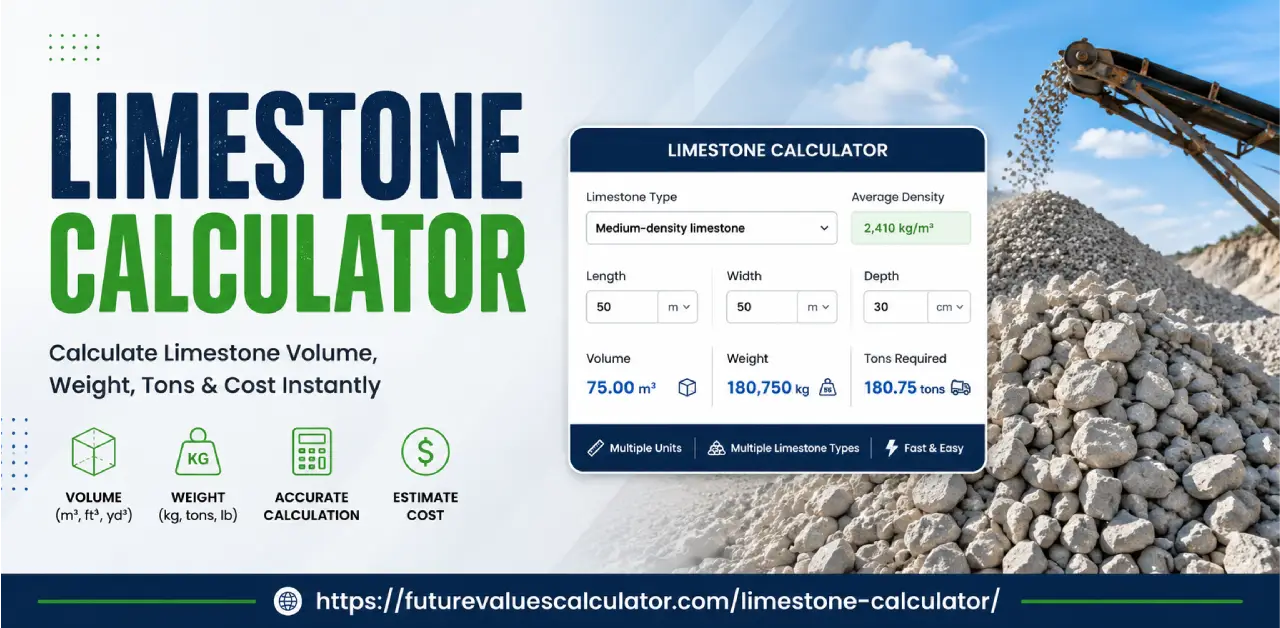
Limestone Calculator for Driveways & Landscaping
A limestone calculator is a smart estimation tool that helps you measure the exact amount of stone needed for any project.
Limestone Calculator
Calculate volume, weight, and total cost estimate for your limestone project.
Specifications
Dimensions
Units & Pricing
What Is a Limestone Calculator?
A limestone calculator is a smart estimation tool that helps you measure the exact amount of stone needed for any project. It removes guesswork and gives clear results in tons of limestone, cubic feet, cubic yards, and cubic meters. Builders in the USA use it for driveways, patios, and road base planning.
This tool also works as a limestone material calculator and construction material calculator, which makes it useful for both homeowners and contractors. It helps reduce waste, control budget, and improve project accuracy. In simple terms, it tells you how much stone you really need before ordering.
How Does a Limestone Calculator Work?
A limestone calculator works by measuring the area, width, and depth of your project. It then uses density to change volume into weight, so you can easily get results in tons.
It also adjusts for different stone types like crushed stone or gravel. That is why tools such as a limestone gravel calculator and crushed limestone calculator give more accurate results than doing the math by hand.
How to Calculate the Amount of Limestone Needed
To calculate limestone manually, you measure length, width, and depth. Then you convert it into cubic feet, cubic yards, or cubic meters. After that, you apply stone density to get the total weight in tons.
However, manual calculation often leads to mistakes. That is why tools like limestone tonnage calculator and limestone volume calculator are widely used in construction projects.
Limestone Calculator Formula
The basic formula is simple:
Volume = Length × Width × Depth
Tons = Volume × Density ÷ 2000
This formula powers every limestone weight calculator and limestone rock calculator. It helps convert space into tons of limestone accurately for construction planning.
How to Use This Limestone Calculator
Using a limestone calculator is very simple. You enter area size, select depth, and choose stone type. Then the system shows total weight and volume instantly.
Most tools also work as a limestone base calculator and driveway material calculator, which makes them perfect for real-world construction use.
Information You Need Before Calculating Limestone
Before using a material quantity calculator, you must collect accurate site data. Without proper measurements, even the best limestone estimate will fail.
Key inputs include:
- Area length and width
- Depth of stone layer
- Limestone type selection
- Density value
- Waste percentage
- Unit system selection
These inputs ensure correct results from any stone calculator or construction material calculator.
Limestone Density Chart by Type
| Limestone Type | Density (lb/ft³) | Density (kg/m³) |
| Crushed Limestone | 95–100 | 1,520–1,600 |
| Limestone Gravel | 95–100 | 1,520–1,600 |
| Limestone Dust | 85–95 | 1,360–1,520 |
| #57 Limestone | 95–100 | 1,520–1,600 |
| #411 Limestone | 90–100 | 1,440–1,600 |
| Rip Rap Limestone | 100–110 | 1,600–1,760 |
This table helps every stone density calculator or quarry stone calculator deliver accurate results for USA construction standards.
Common Limestone Sizes Explained
Limestone comes in different grades. Smaller sizes work for patios. Larger stones support road base and drainage layers. This makes it important for any construction aggregate planning.
For example, #57 stone is ideal for drainage. Meanwhile, #411 is better for compact base layers in driveways.
Limestone Coverage Chart
Coverage depends on depth and compaction. One ton of limestone covers more area at shallow depth. However, coverage reduces as depth increases.
This chart is often used in a coverage calculator or limestone coverage calculator for landscaping and driveway planning.
Limestone Weight Calculator
A limestone weight calculator converts volume into tons using density values. It helps contractors plan truck loads and delivery schedules.
This is essential for avoiding overloading or under-ordering during construction.
Limestone Volume Calculator
A limestone volume calculator measures space in cubic yards or cubic feet. It is the first step before weight conversion.
Without correct volume, no limestone tonnage calculator can give accurate results.
How Many Tons of Limestone Do I Need?
The number of tons depends on area size and depth. A small driveway may need 5–10 tons, while larger projects require much more material.
Users often search how much limestone do I need to avoid ordering mistakes in construction projects.
Limestone for Driveways
Driveways need strong base support. Usually 3–6 inches of crushed limestone is used. This ensures durability and smooth surface stability.
Many users search how to calculate limestone for driveway to avoid sinking and uneven surfaces.
Limestone for Walkways
Walkways require thinner layers. Around 2–3 inches is enough for pedestrian use. It ensures comfort and proper drainage.
This is where driveway stone and landscaping stone calculator tools become useful.
Limestone for Patios
Patios need stable and compact base layers. A limestone calculator for uneven ground area helps adjust for slope and leveling.
Proper estimation avoids cracking and surface shifting.
Limestone for Landscaping
Landscaping uses limestone for decoration and drainage. It improves soil structure and water flow.
Users often ask how much crushed limestone do I need for garden design projects.
Limestone for Garden Beds
Garden beds use smaller stone quantities. Limestone improves drainage and prevents soil compaction.
It is often measured using a fill material calculator or landscaping stone calculator.
Limestone for Construction Projects
Large construction projects require precise estimation. This includes foundations, roads, and commercial structures.
Contractors rely on construction aggregate and quarry stone calculator tools for accuracy.
Limestone for Road Base
Road base requires compact and stable limestone layers. A road base calculator ensures correct thickness and strength.
This prevents road failure and improves load resistance.
Limestone for Foundations
Foundations need accurate stone estimation for structural strength. Poor calculation can lead to instability.
That is why professionals use limestone material calculator tools for safety.
Square Feet to Tons Conversion
This conversion helps translate area into weight. It is essential for construction planning and delivery estimation.
Example: 1000 sq ft may require several tons depending on depth.
Cubic Yards to Tons Conversion
A cubic yard calculator helps convert volume into weight. This is commonly used in USA bulk delivery systems.
It improves logistics and cost estimation.
Cubic Meters to Tons Conversion
Metric conversion is important for international projects. It ensures accurate estimation for global construction standards.
Users often search how to measure limestone in cubic meters for export or engineering work.
Unit Conversion Reference
- Feet
- Inches
- Yards
- Meters
- Centimeters
- Millimeters
This helps every material quantity estimator work across different measurement systems.
Mistakes to Avoid When Ordering Limestone
Many users miscalculate depth or forget compaction. This leads to shortages or extra cost.
Always double-check inputs in any gravel calculator or crushed stone calculator.
Tips to Save Money When Buying Limestone
Buying in bulk reduces cost. Also, accurate calculation avoids waste.
A proper bulk material calculator helps control project expenses.
Factors That Affect Limestone Quantity
- Compaction
- Moisture
- Stone size
- Waste factor
- Uneven ground
These directly affect results from any limestone tonnage calculator.
Benefits of Using a Limestone Calculator
A limestone calculator saves time, reduces waste, and improves accuracy. It also helps in budgeting and logistics planning.
It is essential for both homeowners and contractors in the USA construction market.
Example Limestone Calculations
A 20×20 ft driveway at 4 inches depth may require 6–8 tons of limestone.
This answers common queries like how many tons of limestone do I need for 1000 square feet and how much limestone for a 1000 sq ft driveway 4 inches deep.
FAQs
How much limestone do I need?
You need limestone based on area, depth, and stone type. A limestone calculator gives you exact tons quickly.
How many square feet does one ton of limestone cover?
One ton usually covers about 100–120 sq ft at 2 inches depth. Coverage reduces when depth increases.
What depth should limestone be for a driveway?
Most driveways need 3 to 6 inches of compacted limestone. Heavy vehicles need a thicker base.
How many cubic yards are in one ton of limestone?
One ton of limestone is about 0.6 to 0.8 cubic yards. It depends on density and stone size.
How do I convert cubic feet to tons?
Multiply cubic feet by density, then divide by 2000. This gives you limestone weight in tons.
What is the density of crushed limestone?
Crushed limestone has about 95–100 lb per cubic foot. It may vary slightly by moisture and size.
How much does one cubic yard of limestone weigh?
One cubic yard weighs around 2,500 to 3,000 pounds. The exact weight depends on stone type.
Should I add extra limestone for waste?
Yes, you should add 5–10% extra for waste and compaction. It prevents shortages during installation.
Can I use this calculator for gravel and crushed stone?
Yes, you can use it for gravel, crushed stone, and other aggregates. Only density values change.
What is the best limestone size for a driveway?
#57 and #411 limestone work best for driveways. They compact well and create a strong base.
How much limestone do I need for a patio?
A patio usually needs 3–4 inches of limestone base. Exact quantity depends on total area size.
How much limestone do I need for a garden path?
A garden path needs about 2–3 inches of limestone. Light traffic areas require less material.
Can I calculate limestone in metric units?
Yes, you can use meters, centimeters, and cubic meters easily. The calculator converts everything automatically.
What is the difference between volume and weight?
Volume measures space, while weight measures mass in tons. Limestone density connects both values.
Does limestone settle after installation?
Yes, limestone settles over time due to compaction. That’s why builders add extra material during planning.
Our Featured and other best Calculators
You can also use our Latest and Free Calculators like, Future Value Calculator, Loan EMI Calculator, CPM, CPC & CTR Calculator, 401k Calculator, Construction Calculator, Hourly to Salary Calculator and Property Value Calculator, Pool Salt Calculator, Bench Press Calculator , Gematria Calculator , Losertown Calorie Calculator , 20 weeks from today Calculator , Pine Straw Calculator , Grading Bell Curve Calculator .